Airport
Tung Chung Link
Construction
Noise Management Plan
28 April 2026
Ref: RT25358-AC-02
Prepared
by:
BeeXergy Consulting Limited (BXG)
in association with
Penta-Ocean Construction Co., Ltd
|
Prepared and Checked By: |
|
Approved by |
||
|
|
|
|
||
|
Chuh Augustine
Harmony |
|
FS Cheung |
||
|
Certified Noise
Modelling Professional |
|
Acoustic Expert,
FHKIOA |
||
|
HKIQEP Membership
No.: PM0506 |
|
HKIOA Membership
No.: 008 |
||
|
|
|
|
||
|
||||
Table of Content
6. Identification of Noise Sensitive Receivers
7. Construction Noise Impact Assessment
Appendix A: CONSTRUCTION
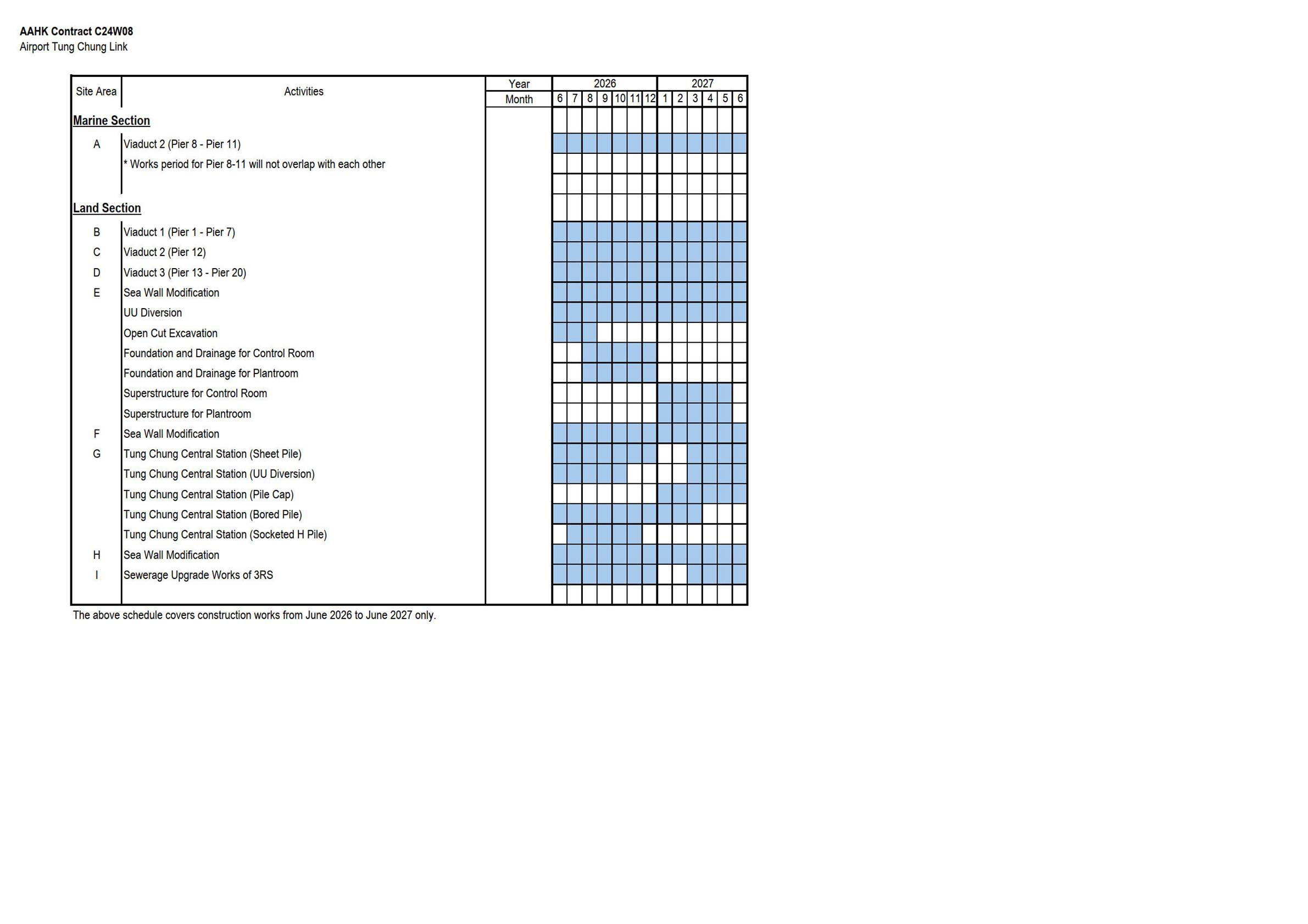
Programme
Appendix B: proposed
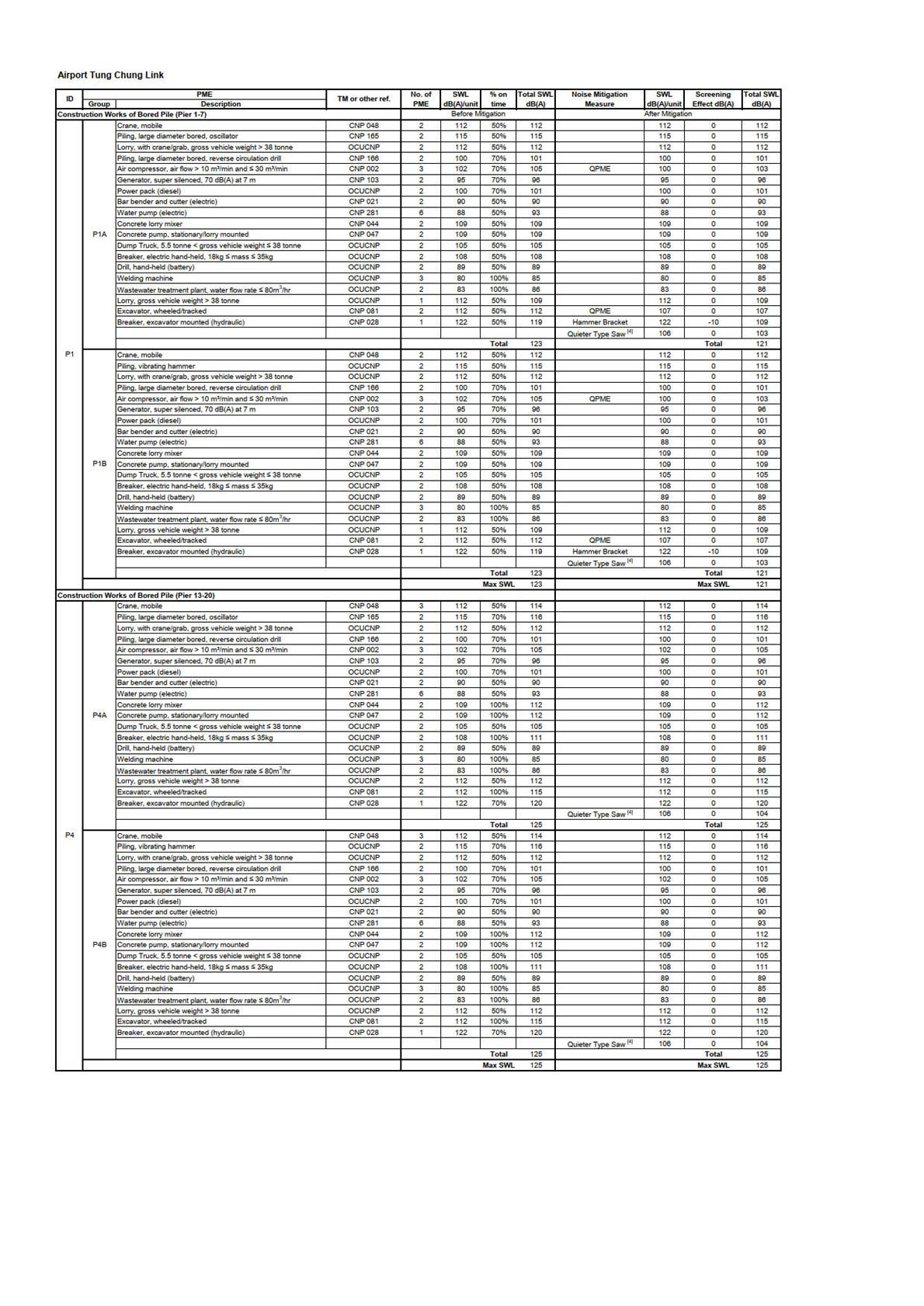
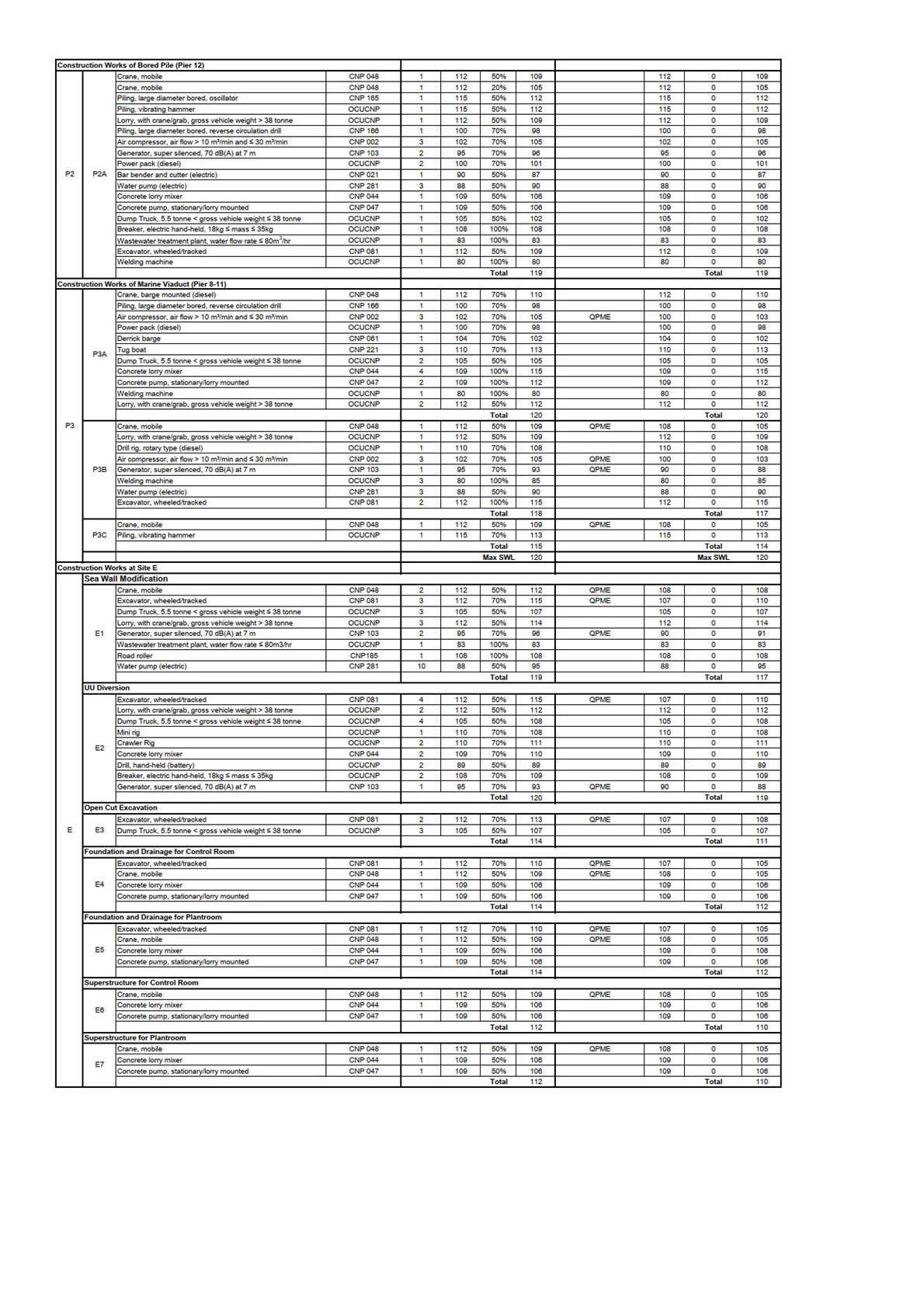
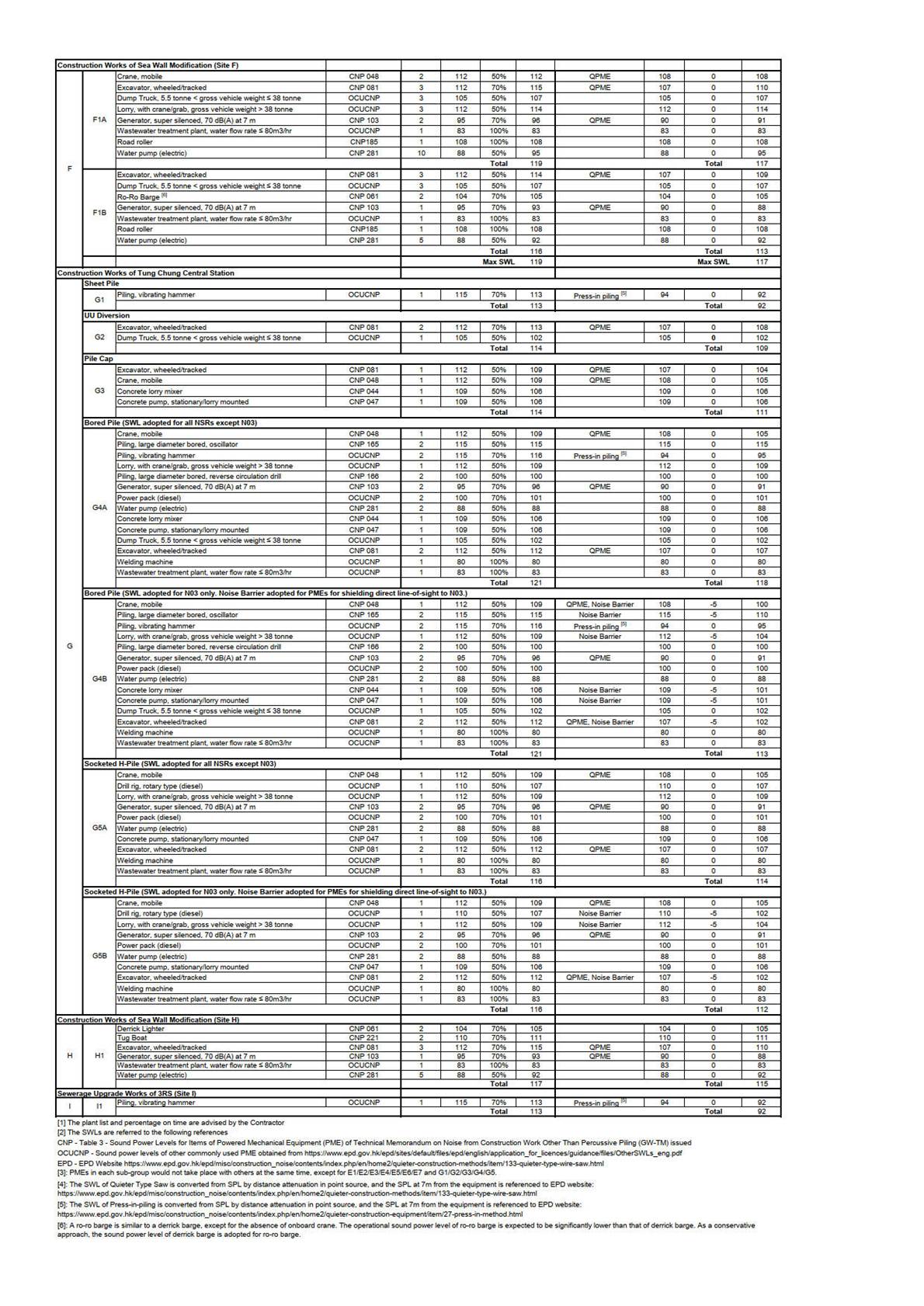
construction plant inventory
Appendix C: Construction noise
calculations (Unmitigated)
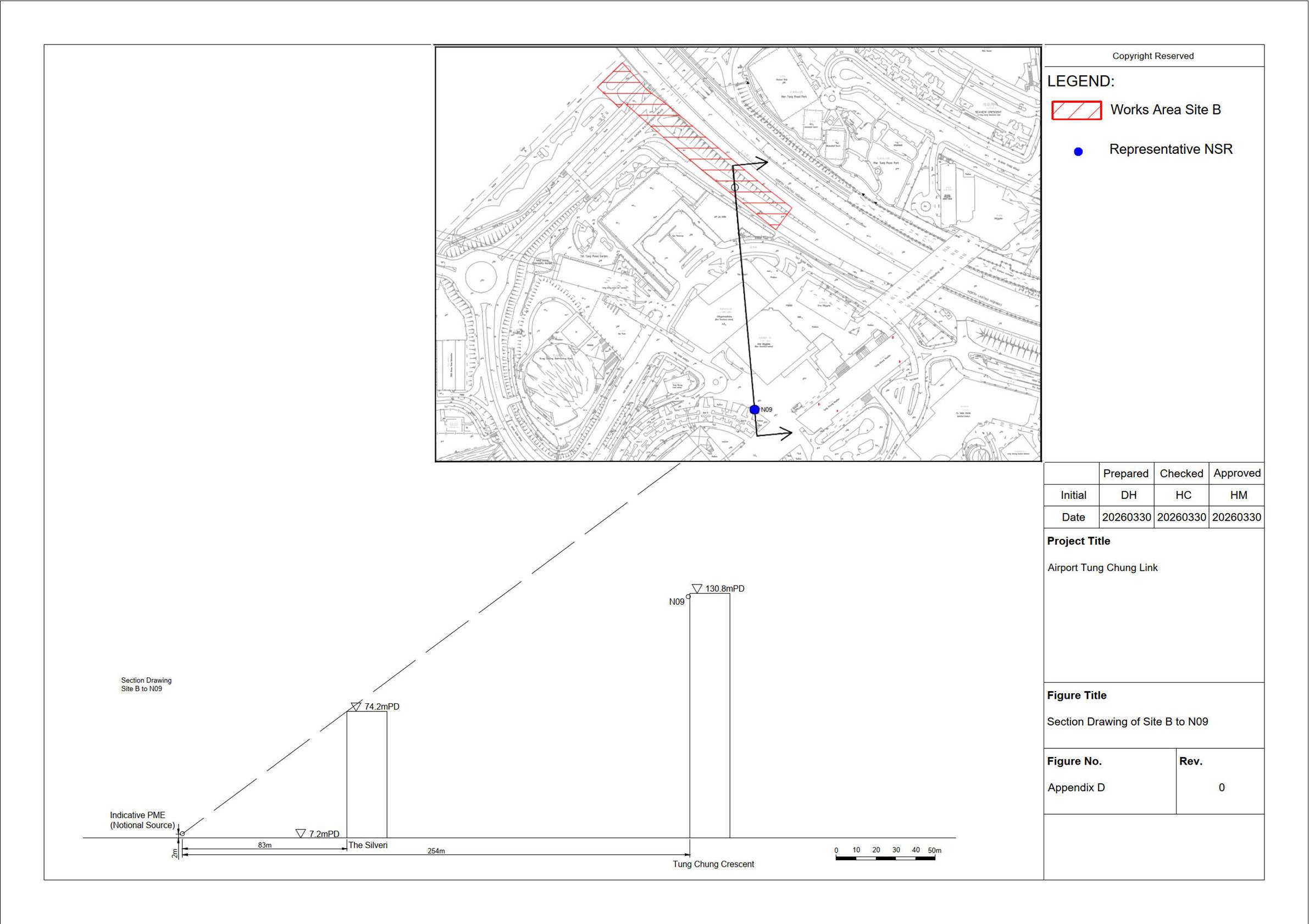
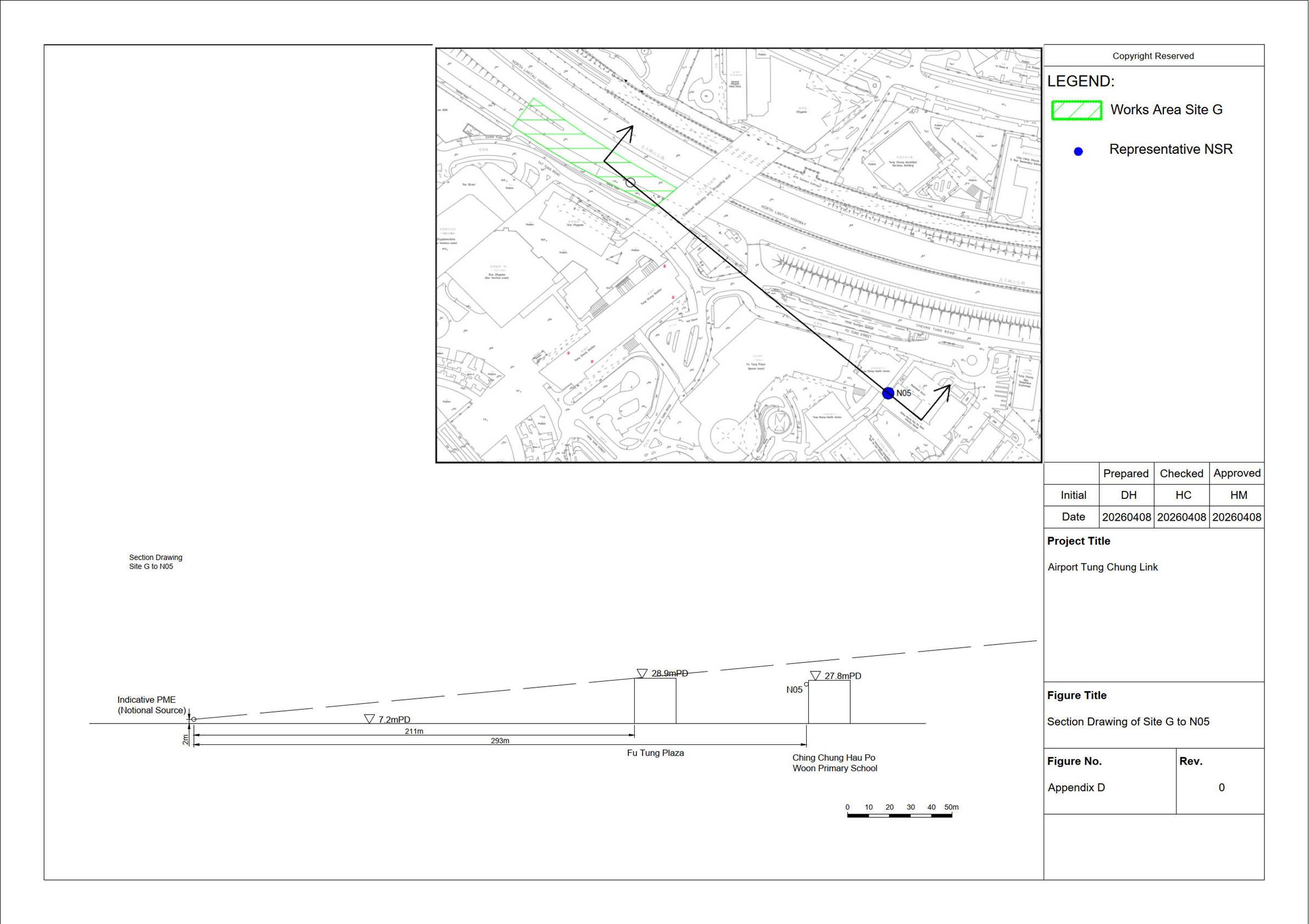
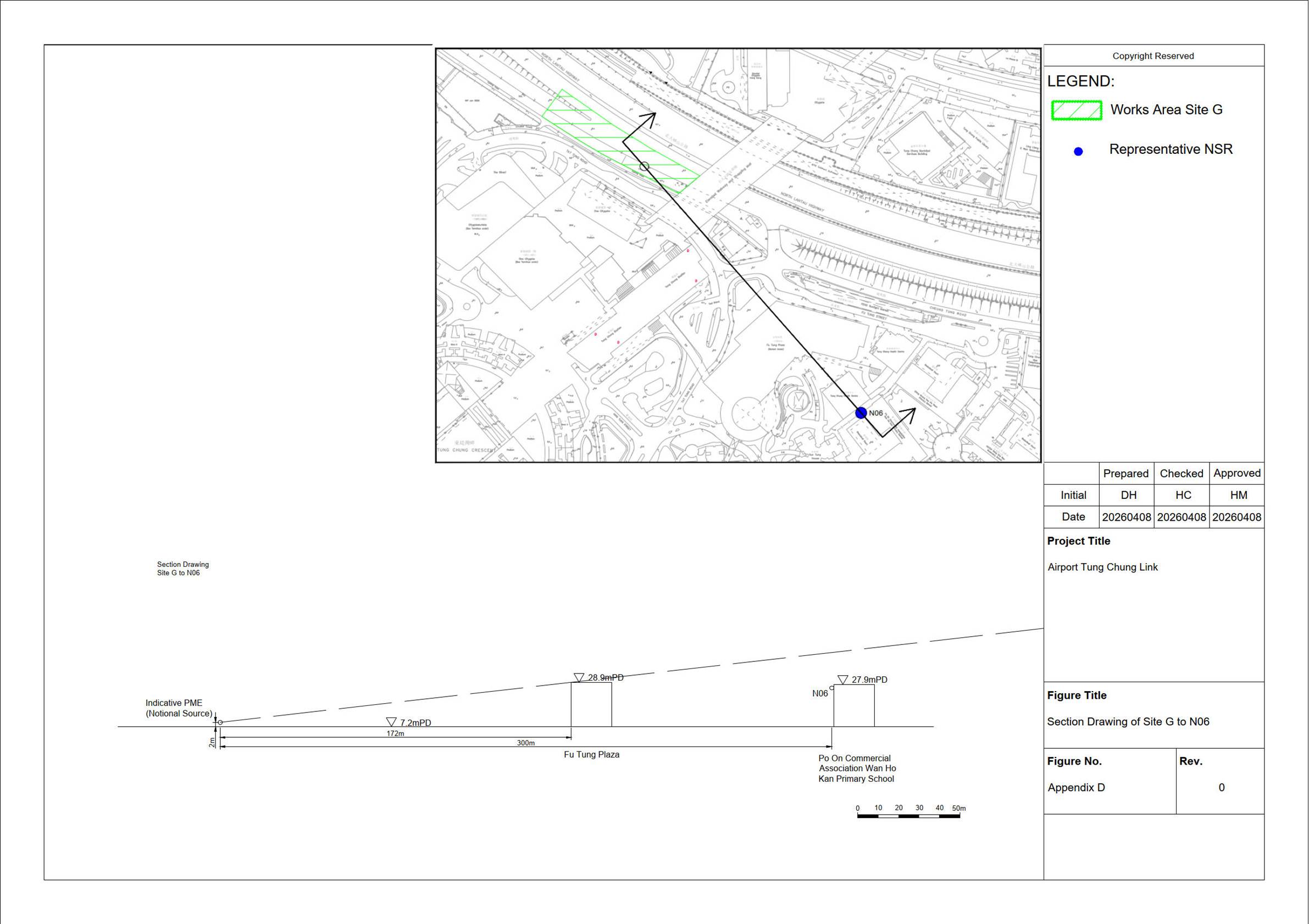
Appendix D: Reference to existing Noise bArrier and
Section Drawing of existing Structures/Barriers
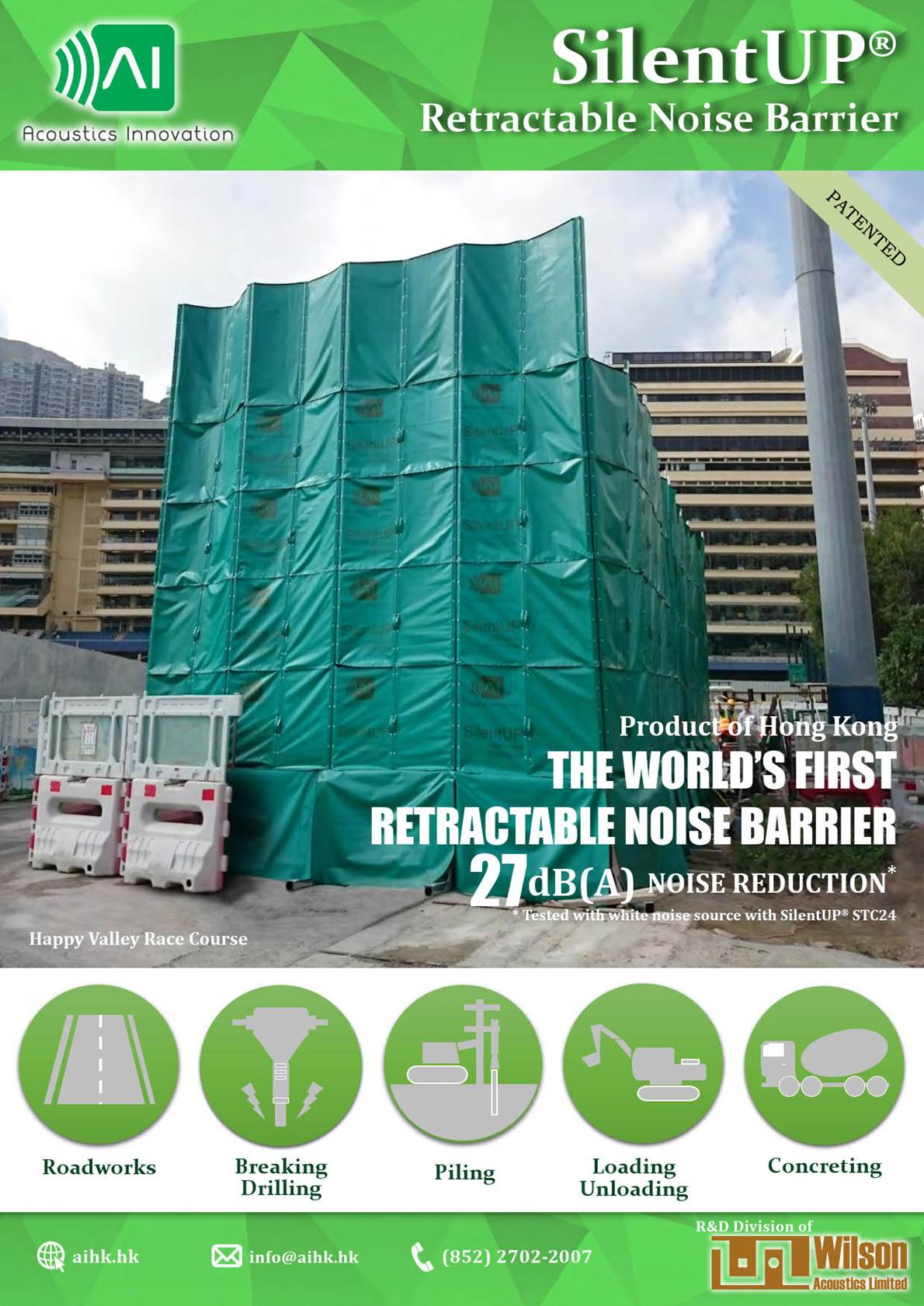
Appendix E: catalogue and
SECTION drawing of noise barrier
Appendix F: Construction noise
calculations (Mitigated)
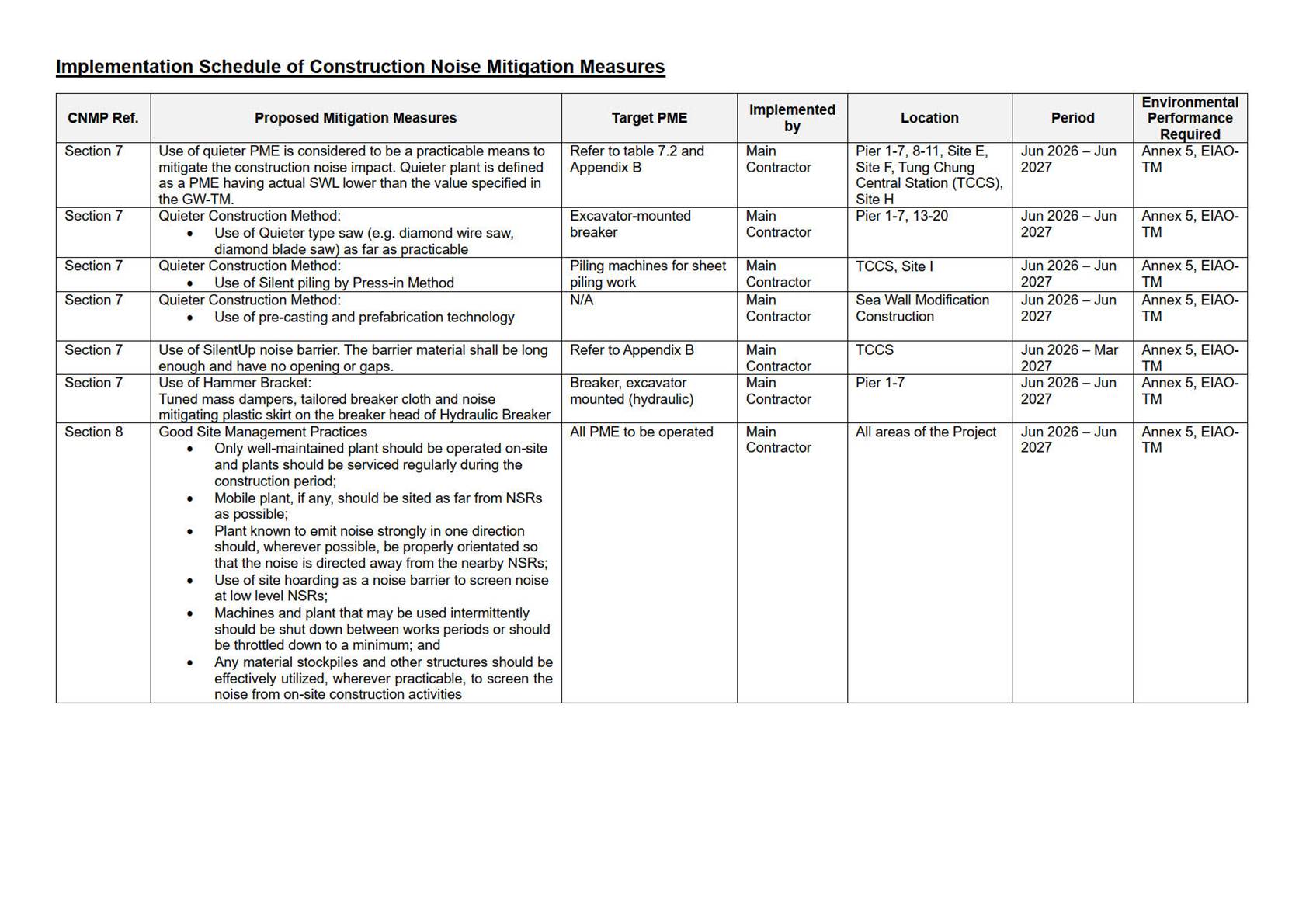
Appendix G: Implementation
Schedule of Proposed Mitigation Measures
Appendix H: Extracted CNMP for
Tung Chung Line Extension project Submissions under EP-614/2022
1.
Introduction
The EIA Report for Airport Tung Chung Link Project
(the ATCL Project) (AEIAR-254/2023) was approved on 26 October 2023. The latest
Environmental Permit (EP) (EР-630/2023/A) was issued on 1 December 2025.
According to Clause 2.12 of the EP, the Permit Holder shall submit a
Construction Noise Management Plan (CNMP) for implementing construction noise
mitigation measures no later than 2 months before the commencement of
construction works of the Project to the Director of Environmental Protection
(DEP).
As stipulated in Clause 2.12 of the EP, 3 hard
copies and 1 electronic copy of the CNMP shall, no later than 2 months before
the commencement of construction works of the Project, be deposited with the
DEP. If there is any change to the construction noise mitigation measures
and/or plant inventory recommended in the submitted CNMP, 3 hard copies and 1
electronic copy of an updated CNMP shall, no later than 1 month before the
implementation of any such change, be deposited with the DEP. The CNMP and updated
CNMP shall identify the noise source inventory and assess the effectiveness of
construction noise mitigation measures, including the use of quieter powered
mechanical equipment, quieter construction methods, noise barriers, enclosures
and insulation fabric as recommended in the approved EIA Report (Register No.
AEIAR-254/2023) for mitigating the construction noise impact of the Project.
The CNMP and updated CNMP shall include an implementation schedule in table
form to clearly list out the mitigation measures to be implemented, and the
implementation party, location, timing, and environmental performance required
for implementation of the mitigation measures. The CNMP and updated CNMP shall
be prepared and checked by a Certified Noise Modelling Professional as
recognized by the Hong Kong Institute of Qualified Environmental Professionals
Limited or other professional as agreed by the Director, certified by the ET
Leader and verified by the IEC as conforming to the relevant information and
recommendations of the approved EIA Report (Register No. AEIAR-254/2023). All
mitigation measures recommended and requirements specified in the CNMP and the
updated CNMP shall be fully implemented.
The CNMP covering the construction works from
February to May 2026 was deposited to EPD according to EP Condition 2.13. This
updated CNMP focused on the construction works conducted during June 2026 to
June 2027 only and the remaining construction period is still under planning
and subject to change. The CNMP will be regularly reviewed and updated to
reflect any changes in construction work or site arrangements, ensuring
continuous compliance. The Contractor will submit other CNMP for the remaining
construction period once the details become available. If there is any update
on the construction works conducted from June 2026 to June 2027, a revised CNMP
will be submitted to the EPD.
2.
Environmental
Legislation
The Noise Control Ordinance (NCO) (Cap. 400)
provides the statutory framework for noise control.
The Environmental Impact Assessment Ordinance (EIAO) (Cap. 499) provides the
framework for assessment of the noise impact for designated projects
Reference to the EIAO and the relevant technical
memoranda has been made for the assessment of noise impacts. Annexes 5 and 13
of the Technical Memorandum on Environmental Impact Assessment Process
(EIAO-TM) set out the criteria and guidelines for evaluating noise impacts.
Assessment procedures and standards are set out in the following technical
memoranda and Guidance Note:
·
Technical Memorandum on Environmental Impact Assessment Process (EIAO-TM);
·
Technical Memorandum on Noise from Construction Work in Designated Areas
(DA-TM);
·
Technical Memorandum on Noise from Construction Work other than
Percussive Piling (GW-TM);
·
Technical Memorandum on Noise from Percussive Piling (PP-TM);
·
EIAO Guidance Note – Preparation of Construction Noise Impact Assessment
under the Environmental Impact Assessment Ordinance (GN9/2023).
3. Noise
criteria
The
Technical Memorandum on Environmental Impact Assessment Process (EIAO-TM)
stipulates criteria of 65 – 75 dB(A) for daytime construction activities, as
shown in Table 3.1.
Table 3.1
Noise standards for
daytime construction activities
|
Use |
Noise Standards, Leq
(30min) dB(A) |
|
0700 – 1900 hours on any day not being a Sunday or
general holiday |
|
|
All domestic premises, Temporary housing
accommodation, Hostels, Convalescent homes, and Homes for the aged |
75 |
|
Places of public worship, Courts of law, and Hospitals and medical
clinics |
70 |
|
Educational
institutions (including kindergartens and nurseries) |
70 65
(During Examination) |
Notes:
[1] The above standards
apply to uses which rely on opened windows for ventilation and are assessed at
1m from the external façade.
[2] A Construction
Noise Permit shall be required for carrying out relevant construction work
during restricted hours under the Noise Control Ordinance. In case the
applicant would like to evaluate whether carrying out relevant construction
works during restricted hours under the Noise Control Ordinance is feasible or
not in the context of programming construction works, reference should be made
to relevant technical memoranda issued under the Noise Control Ordinance.
4. Assessment Methodology
The
assessment of noise impacts from the construction (excluding percussive piling)
of the Project has been based on the methodology given in Annex 13 of the
EIAO-TM. The typical approach is summarized as follows:
- Formulate construction programme
and work sequences;
- Identify representative NSR that may be
affected by the construction of the Project;
- Establish the construction plant inventory;
- Assign Sound Power Level (SWL) for each piece
of PME based on the GW-TM and the list of Sound Power Level of other
commonly used PME;
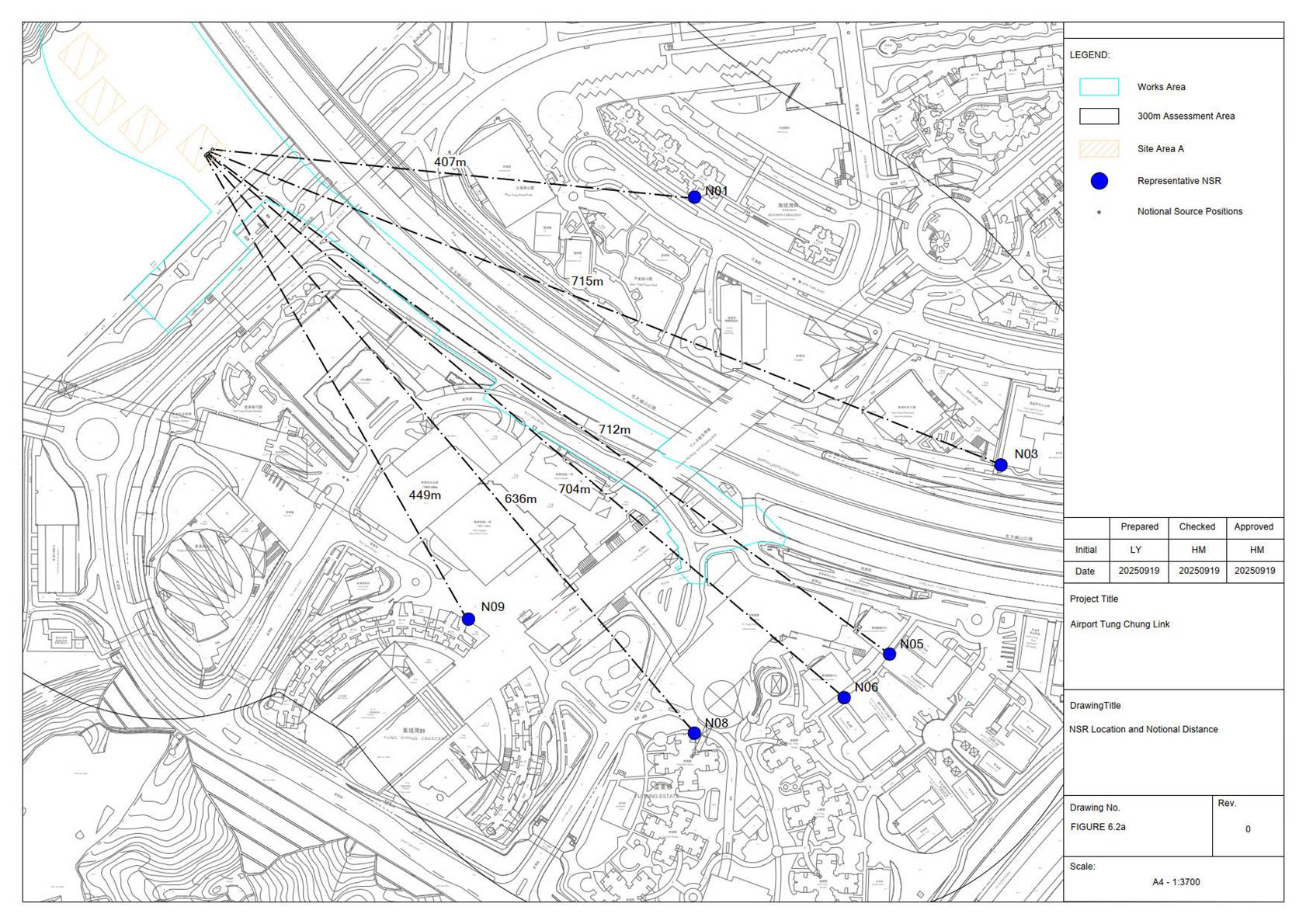
- Calculate the correction factors based on the
distance between the NSR and the notional noise source positions at
different construction works areas;
- Apply noise corrections in the calculations
for distance, operation time, screening and façade correction, if any;
- Predict the construction noise levels at NSR
and compare against the noise criteria; and
- Determine mitigation measures, as necessary,
and assess any residual impacts.
5. Construction Programme
The
Contractor has confirmed this scope of work, ensuring the noise assessment is focused
and accurate. No construction activities other than specified below are
permitted during this specific period.
The proposed
construction works will be carried out only between 07:00 and 19:00 hours on any day not being a
Sunday or general holiday. The
Contractor shall submit other CNMP reports for the any changes in construction
period. As advised by the Contractor and broadly indicated in the construction programme in Appendix A, the major construction works of the Project
during June 2026 to June 2027 include:
- Bored pile for Bridge Pier 1 - Pier 20
- Sea wall modification
- UU Diversion
- Open Cut Excavation
- Foundation, Drainage and Superstructure for
Control Room and Plantroom
- Tung Chung Central Station (TCCS) Construction
of sheet pile, UU diversion, pile cap, bored pile and socketed H pile
6. Identification of Noise Sensitive Receivers
The Project site is situated between Tung Chung
town centre and Hong Kong Port (HKP) Island. The location of the Project is
shown in Figure 6.1.
The noise sensitive receivers in the assessment area mainly comprise
residential uses and the government, institution or community uses at Tung
Chung town centre. The assessment area for noise impact generally include areas within 300m from the boundary of the Project
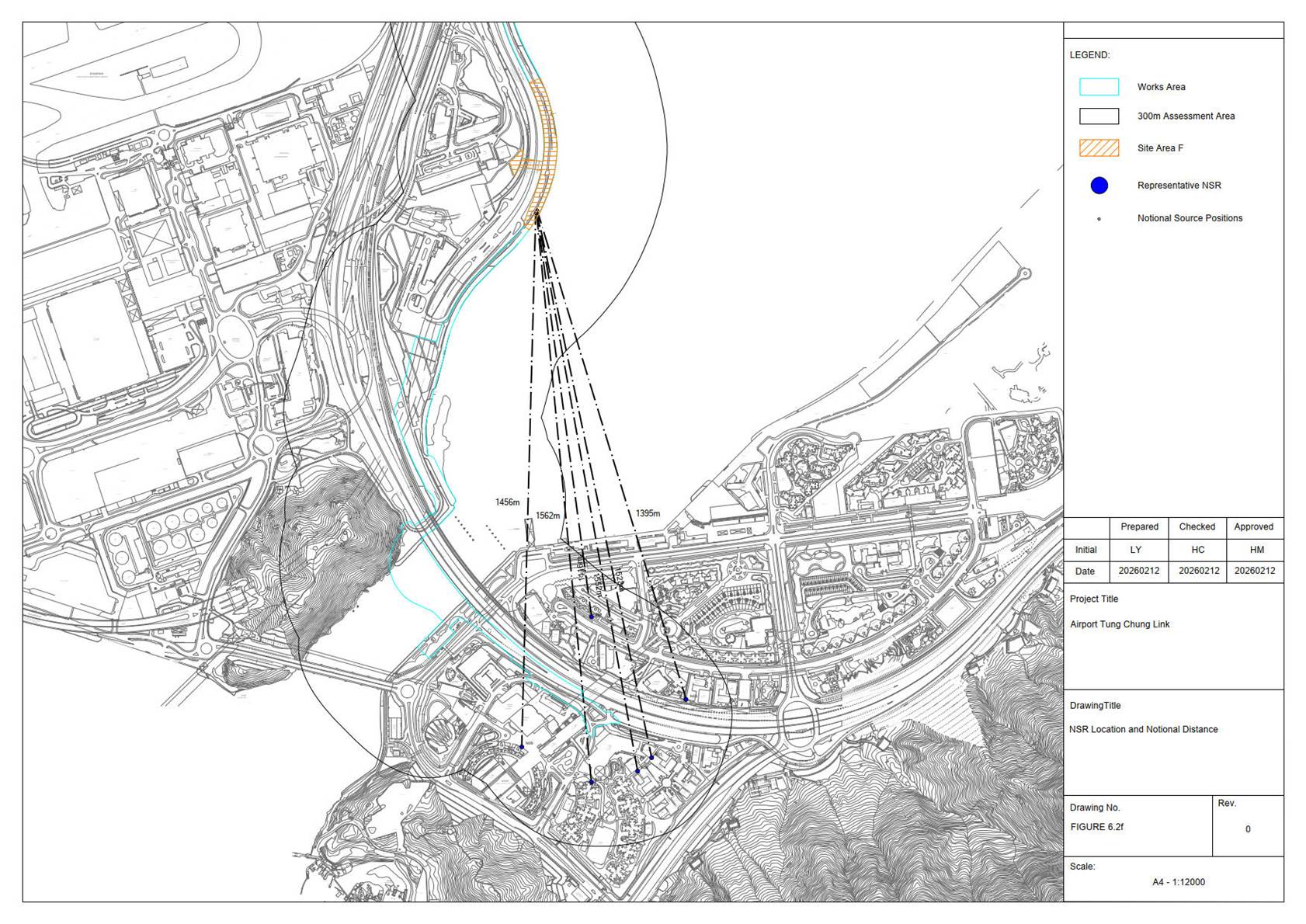
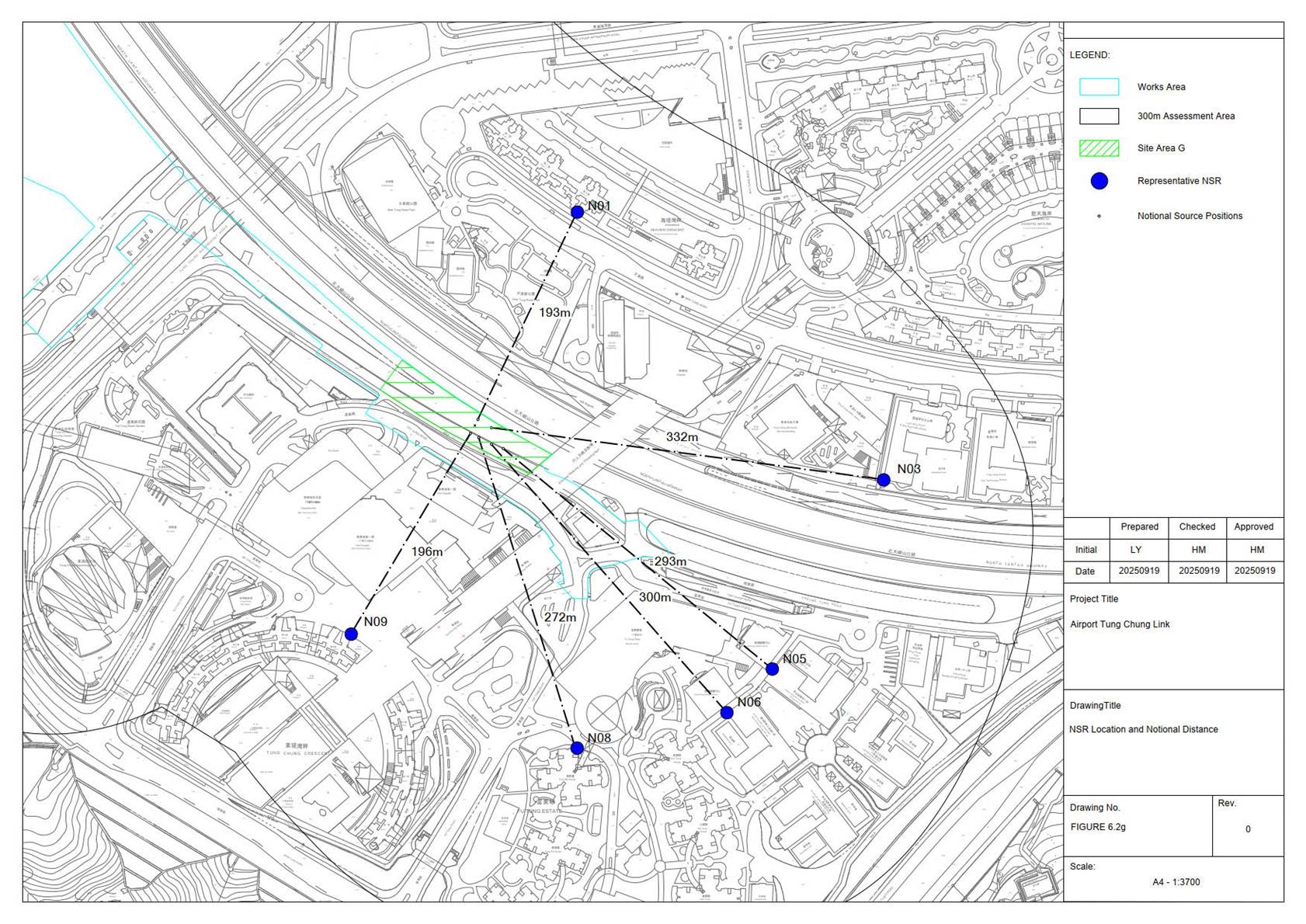
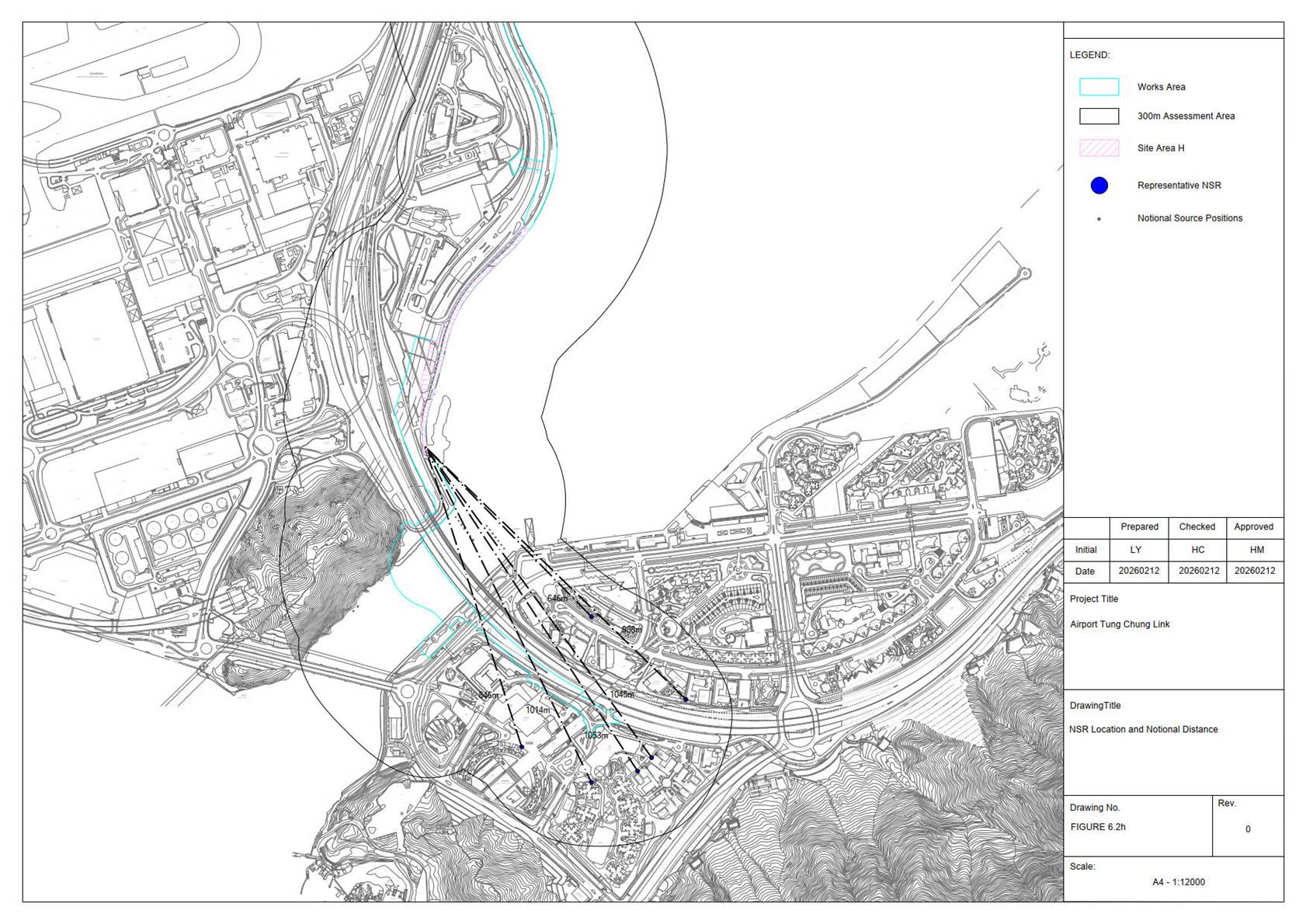
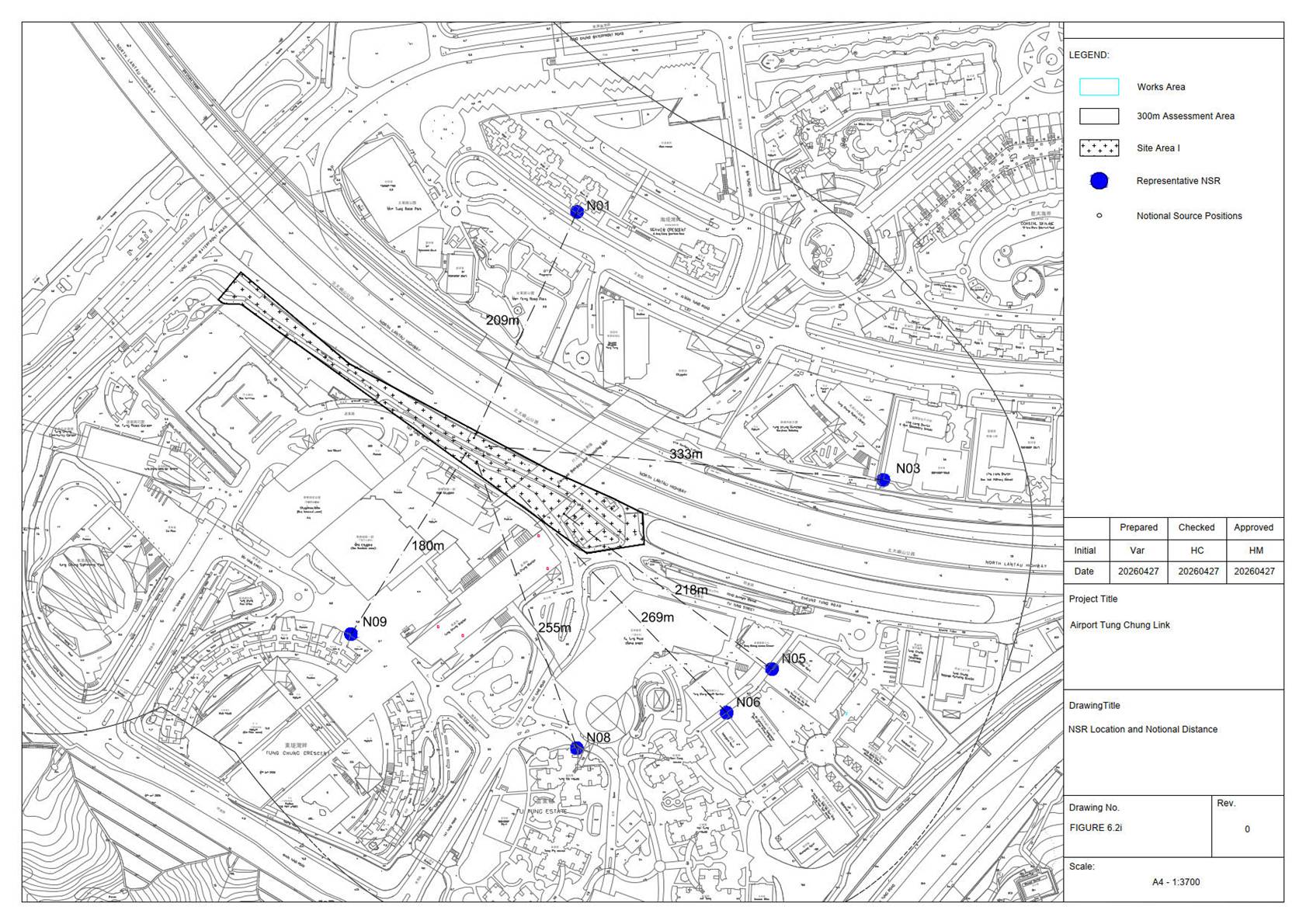
and the works of the Project. Noise Sensitive Receivers (NSRs) within a distance of 300m from the boundary of the Project and the
works of the Project have been identified. NSRs located within the first layer
from the Project site and having openable windows for ventilation were selected
as representative NSRs for assessment.
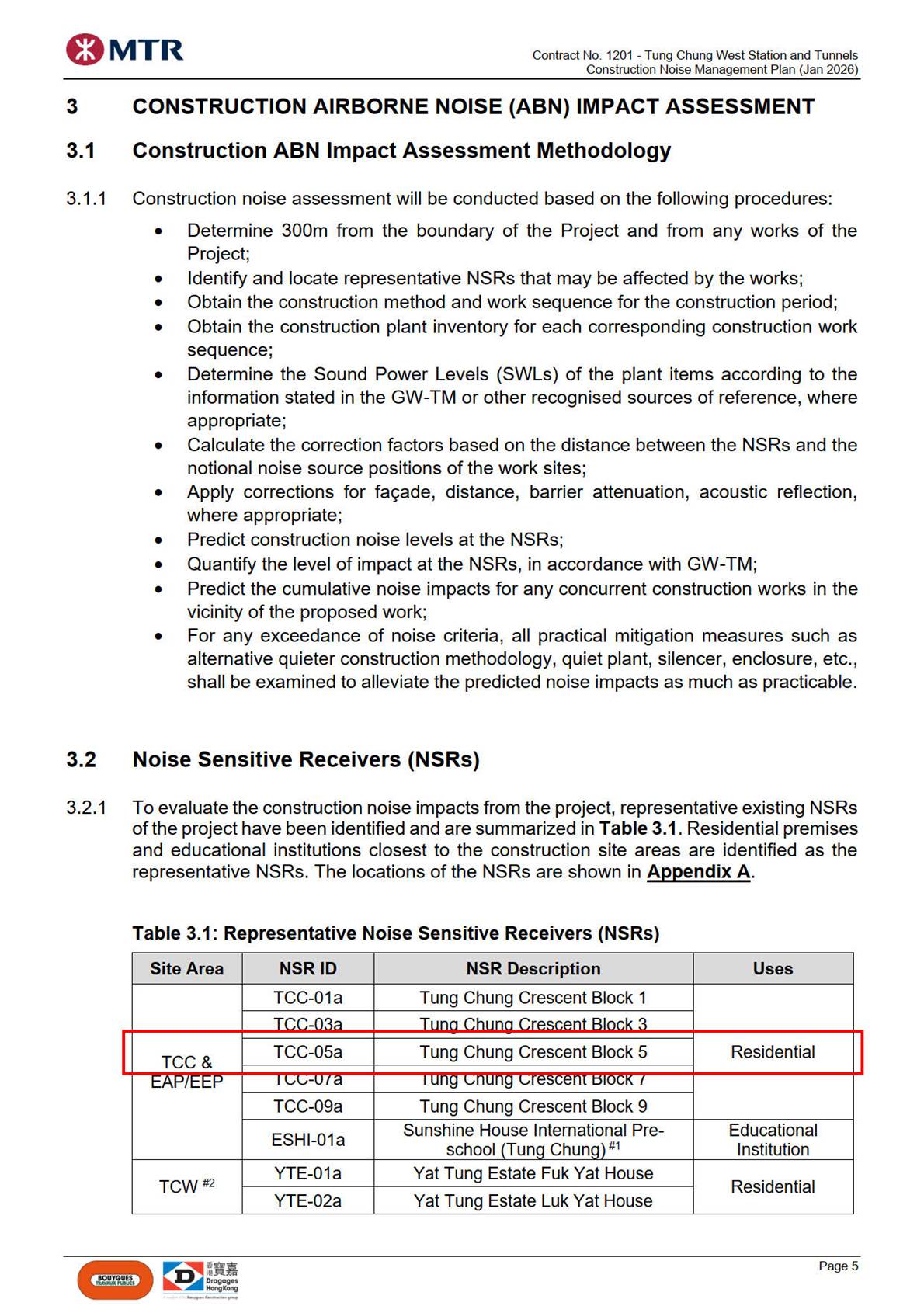
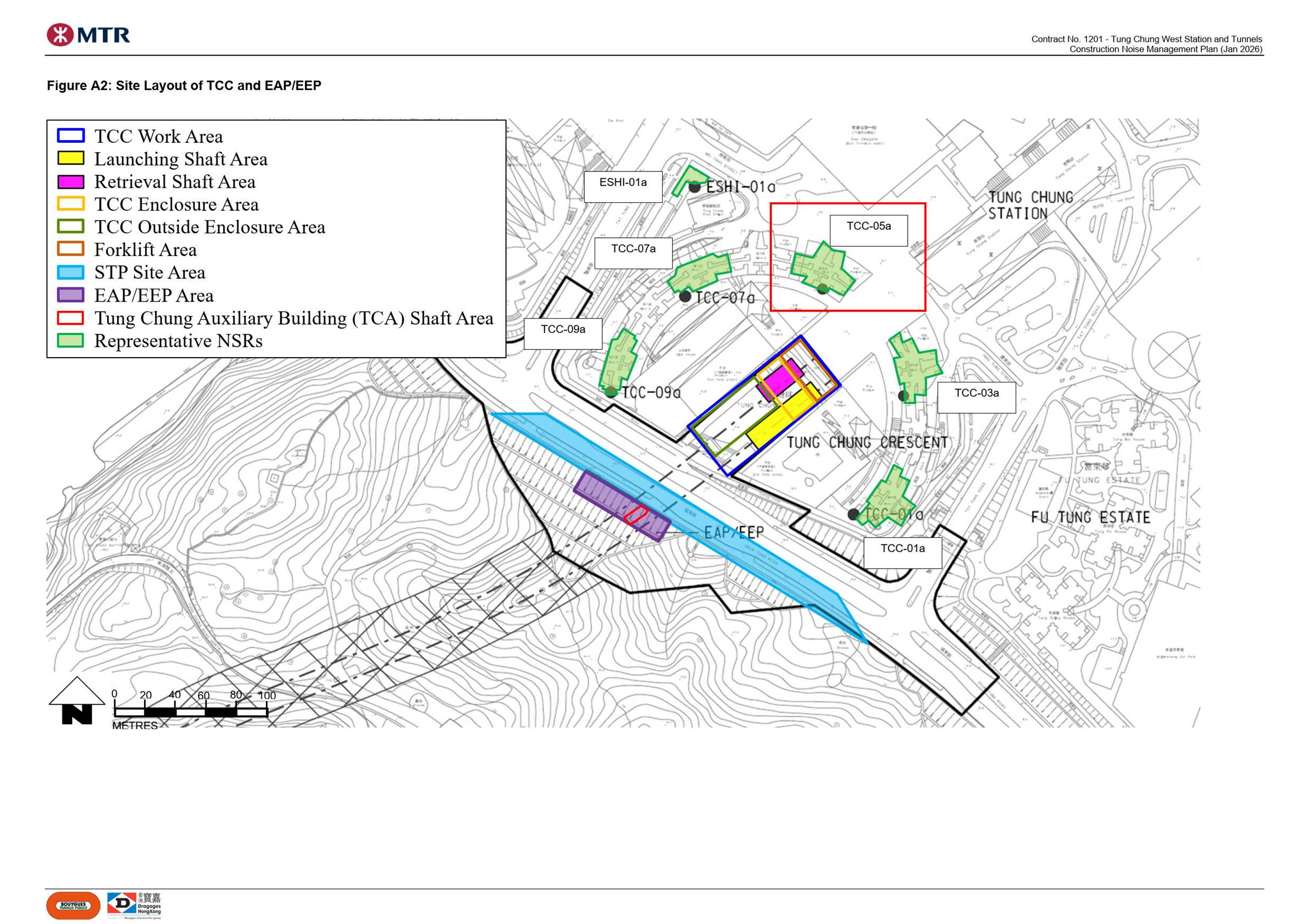
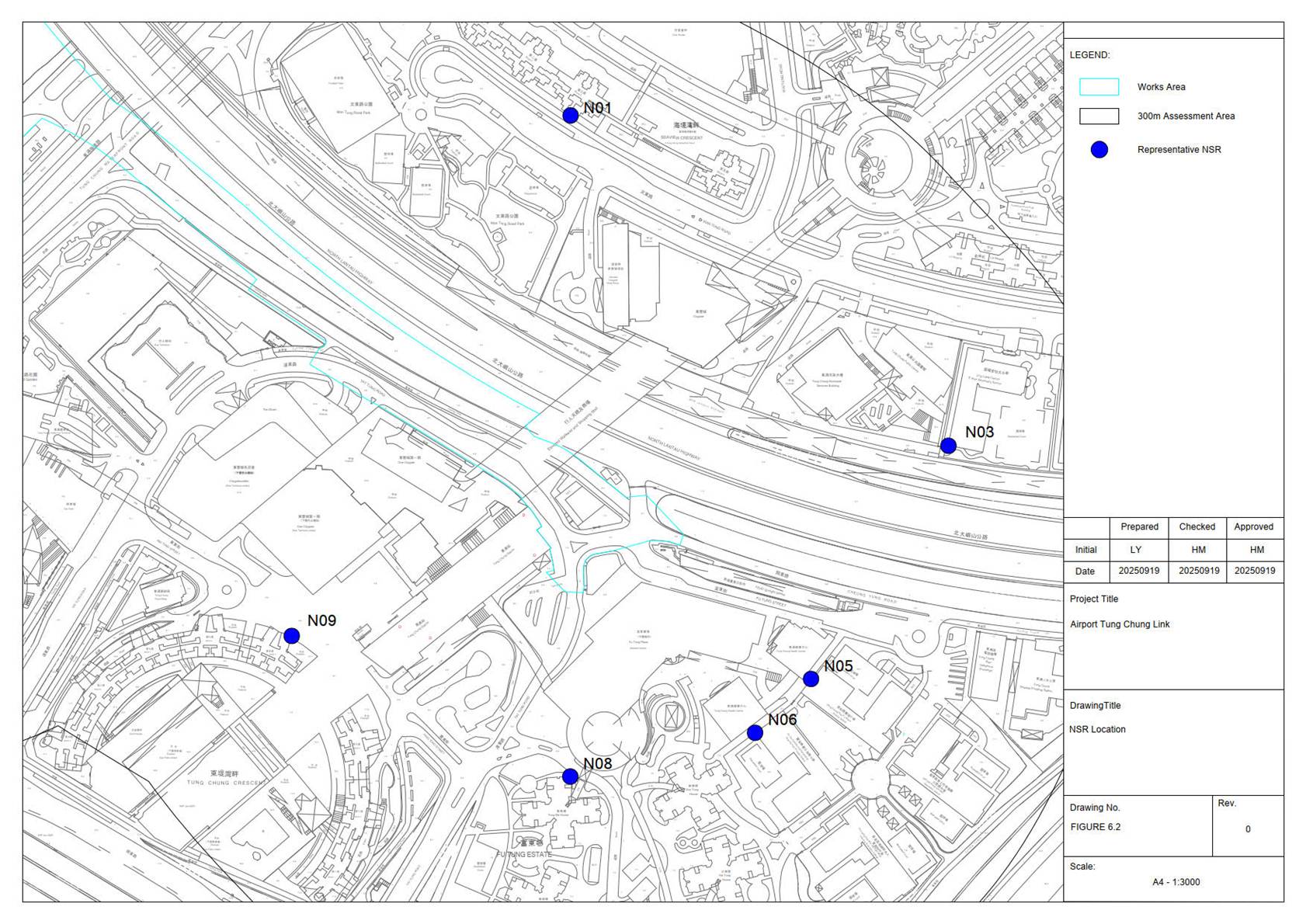
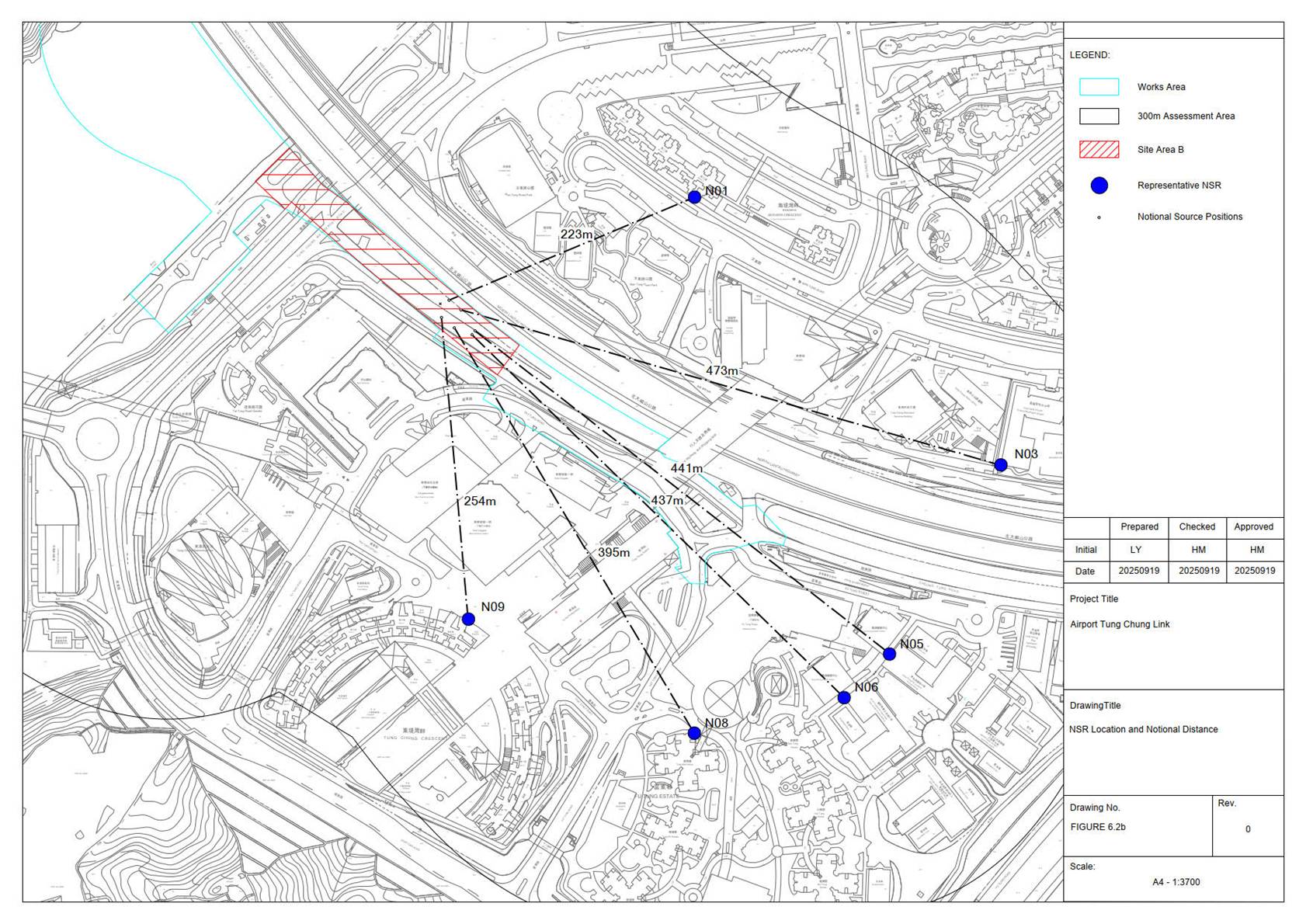
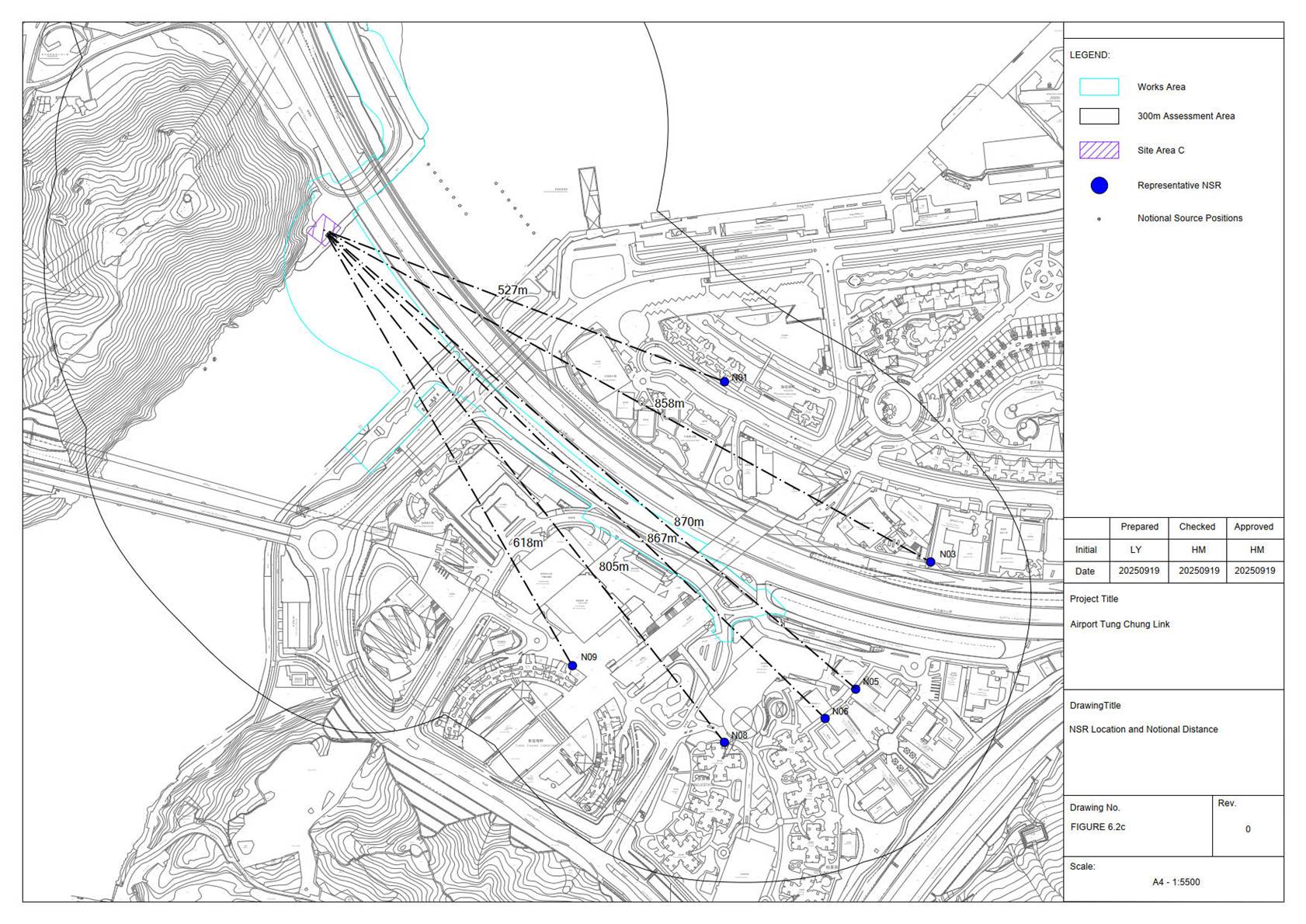
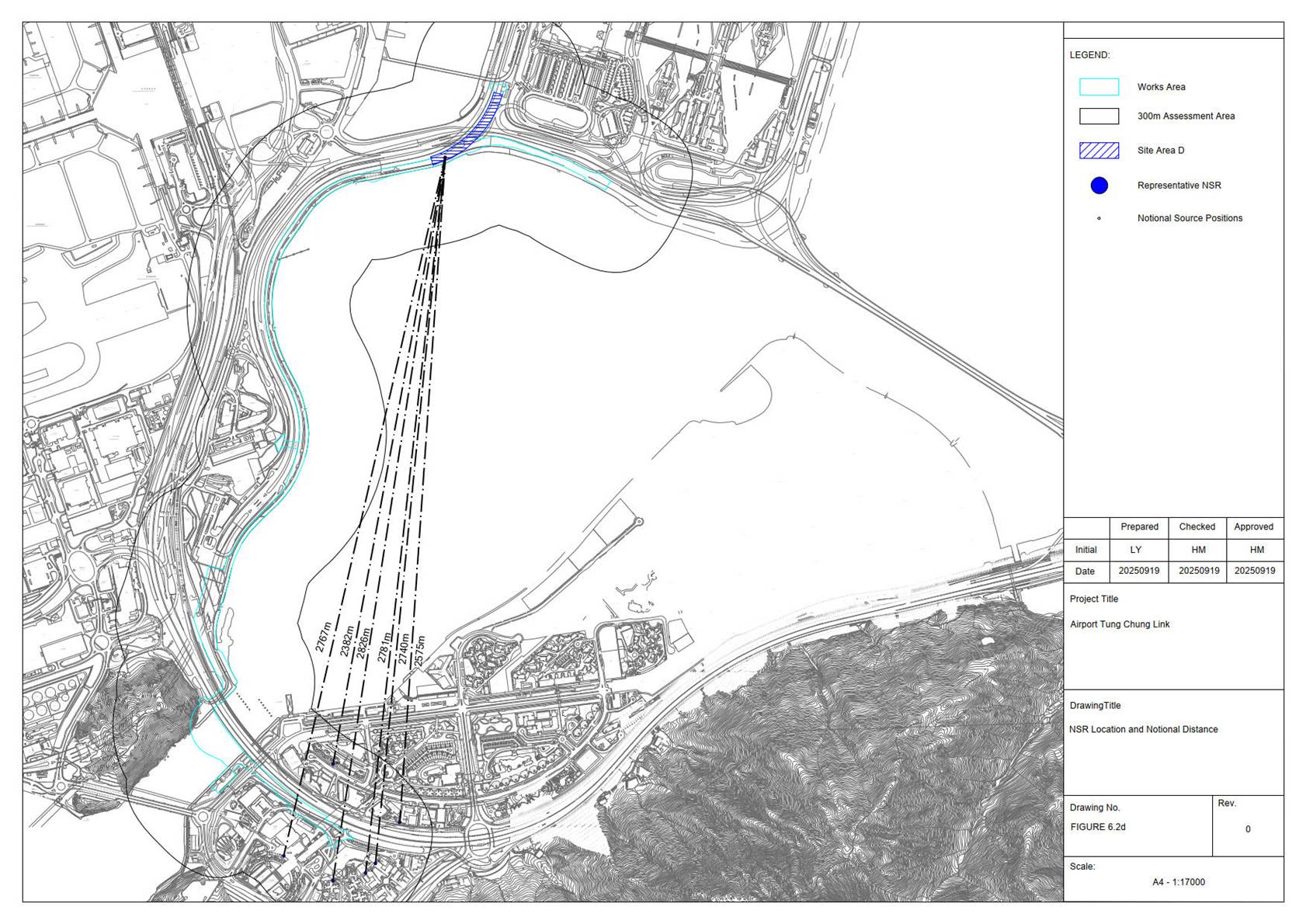
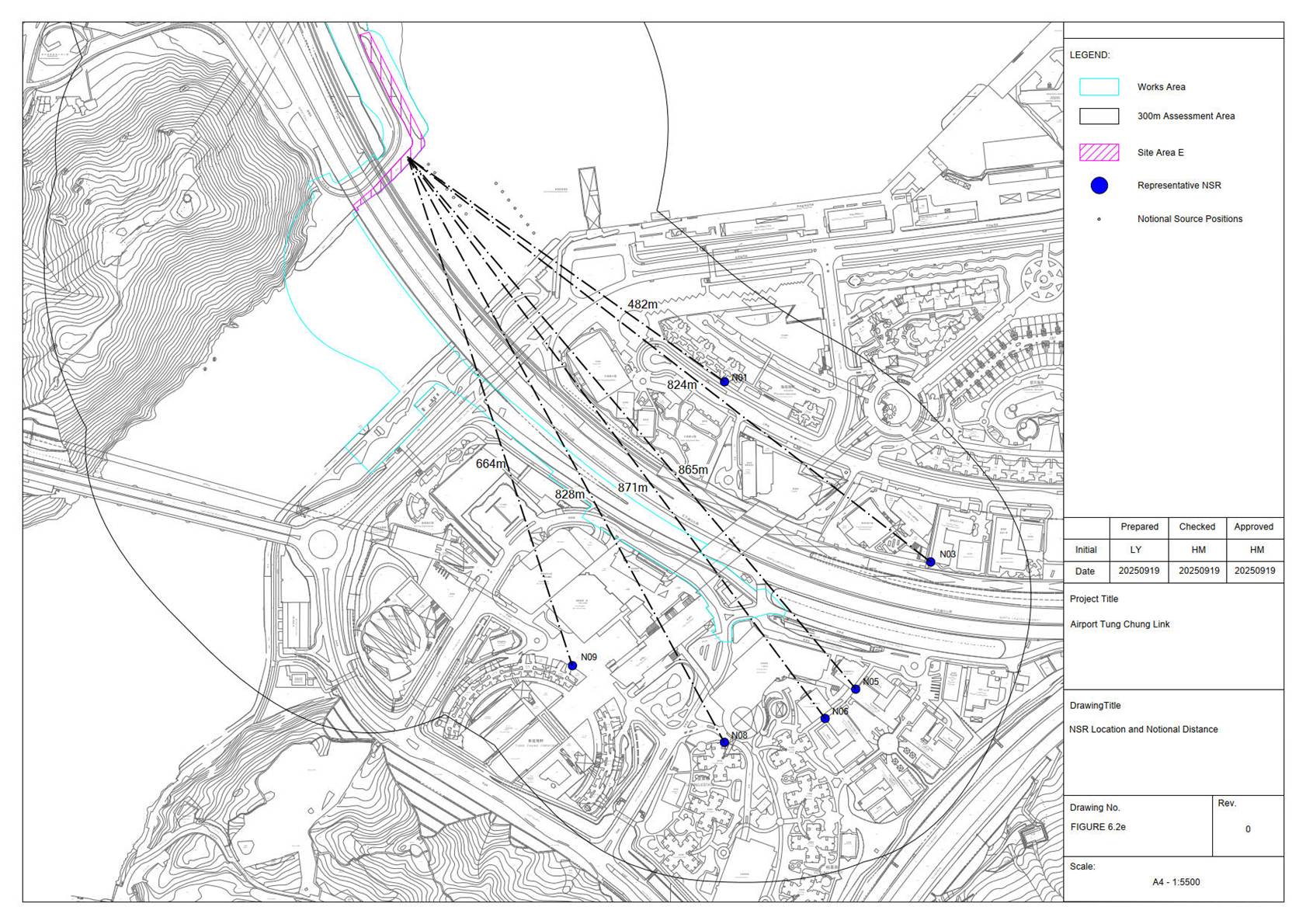
The identified existing, committed and planned
NSRs, if any, within the assessment area are presented in Table 6.1 and
their locations are shown in Figure 6.2.
Table 6.1 Noise Sensitive Receivers (NSRs) Identified
|
NSR ID |
Description |
Uses |
Existing/
Planned |
|
N01 |
Seaview Crescent |
Residential |
Existing |
|
N03 |
Ling Liang Church E Wun Secondary School |
School |
Existing |
|
N05 |
Ching Chung Hau Po Woon Primary School |
School |
Existing |
|
N06 |
Po On Commercial Association Wan Ho Kan
Primary School |
School |
Existing |
|
N08 |
Fu Tung Estate |
Residential |
Existing |
|
N09 |
Tung Chung Crescent |
Residential |
Existing |
|
N10 [3] |
Priests’ Quarters of the Planned Visitation
Church Development |
Residential |
Planned |
Notes:
[1] The assessment
will only include NSRs which rely on opened windows
for ventilation.
[2] Only the first layer of NSRs has been selected for assessment.
[3] The tentative occupancy year of the
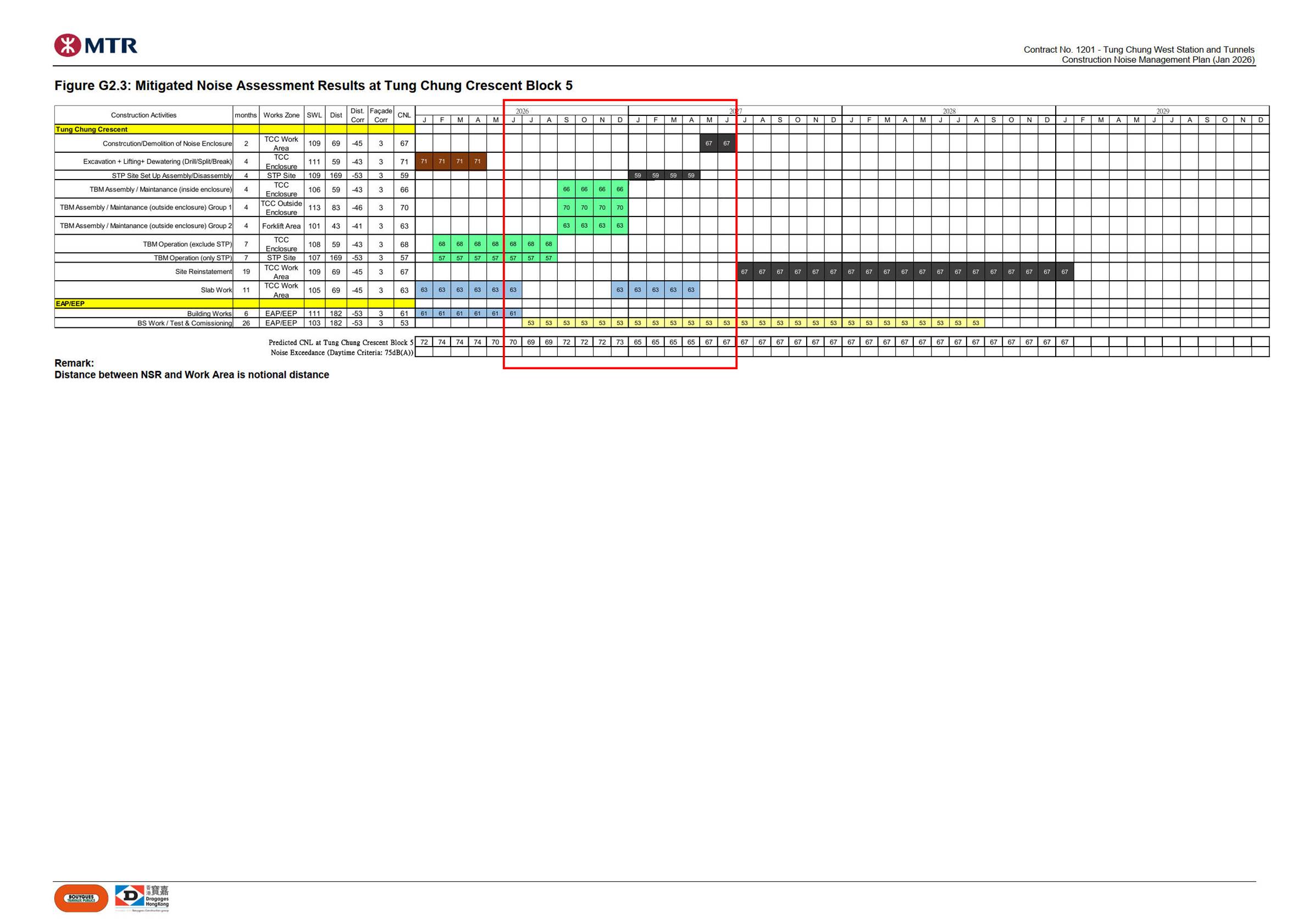
planned NSR (N10) is 2028; therefore, it is not included in the assessment in
this CNMP, and will be included in future CNMP as and
when appropriate.
7.
Construction
Noise Impact Assessment
Prediction and Evaluation of Construction Noise Impact (Unmitigated)
Potential source of noise
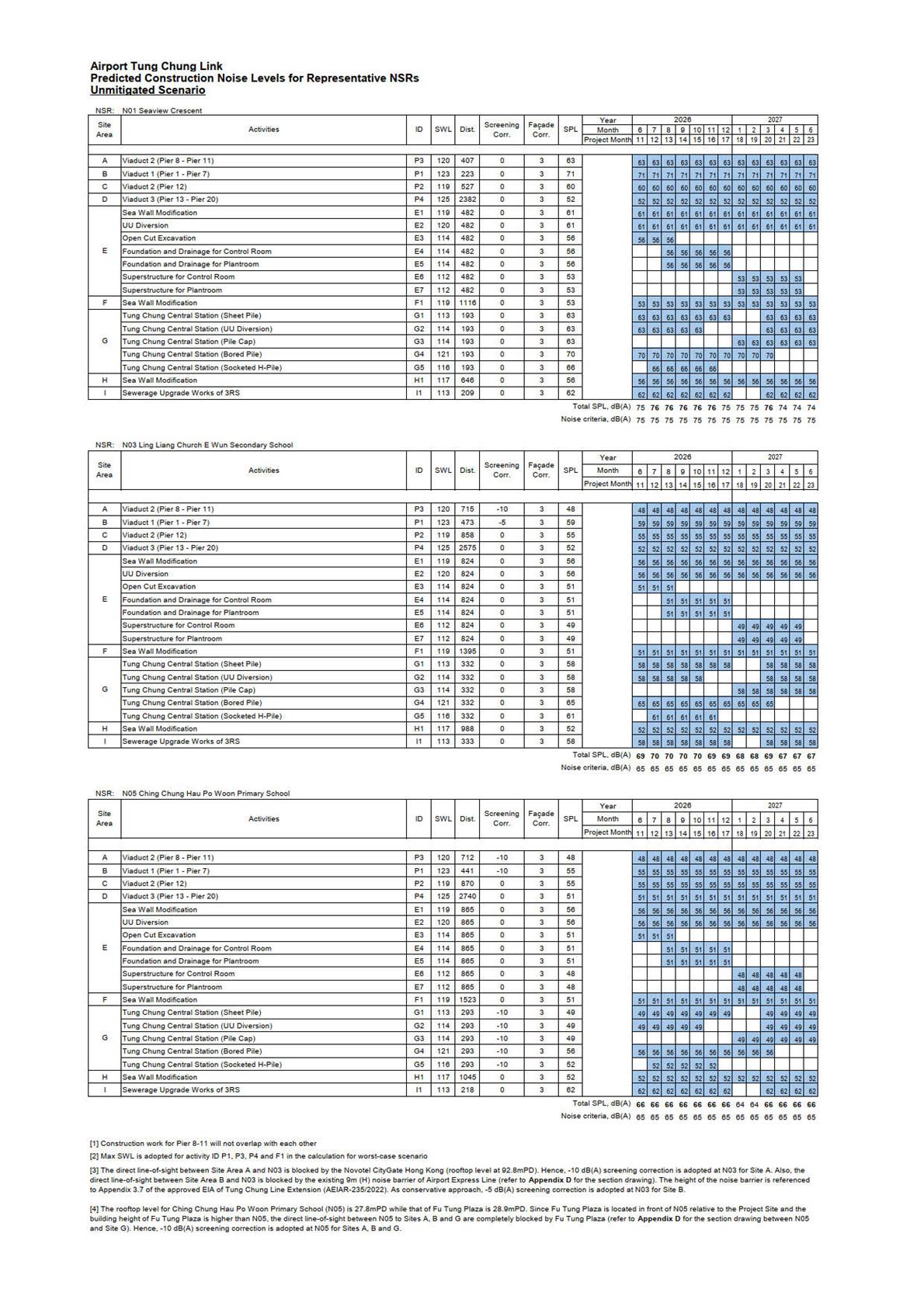
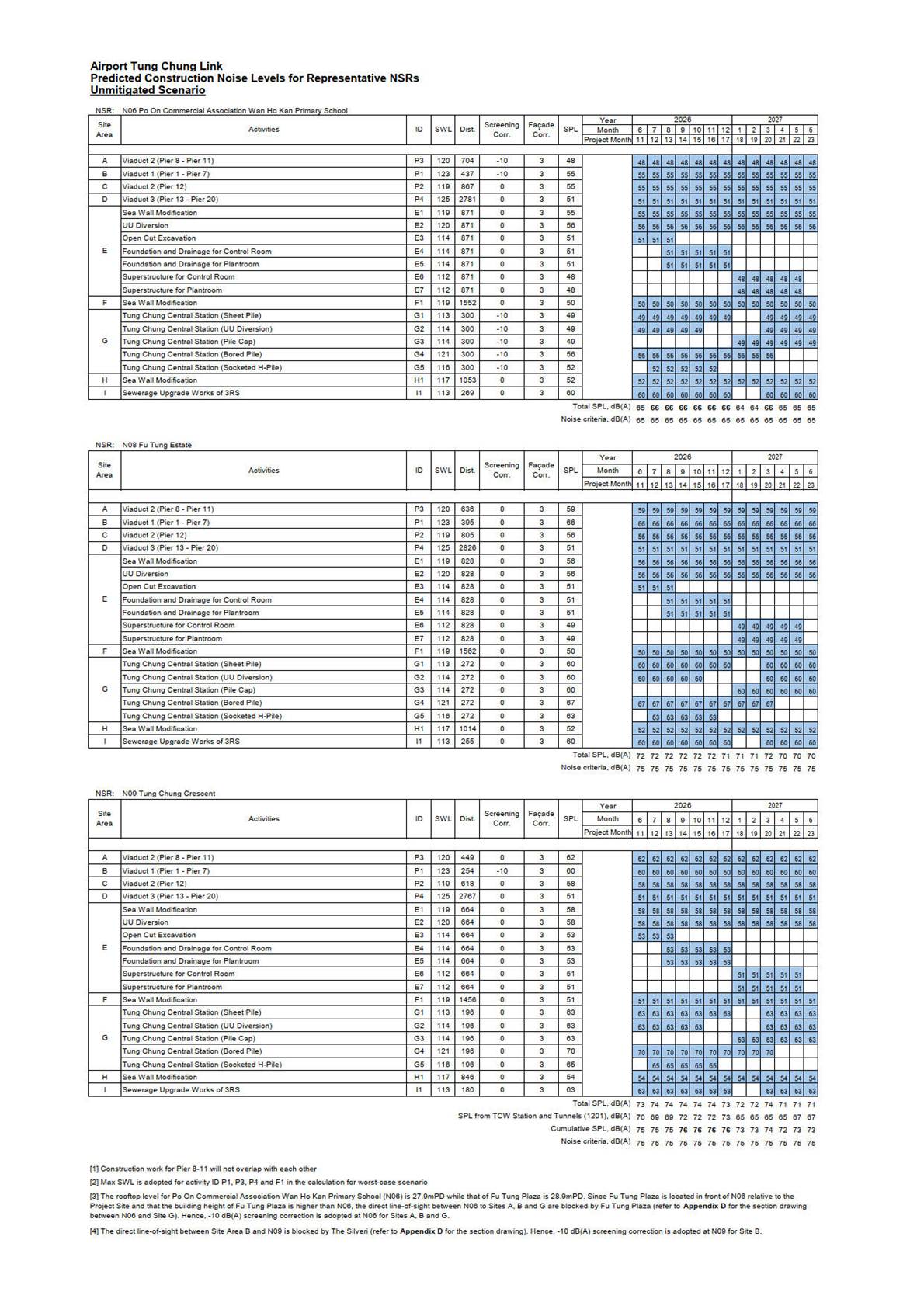
impact arising from the construction of the Project would be the use of Powered Mechanical Equipment (PME) for various construction activities. The percentage on-time for each PME has been estimated individually for
each construction activity to ensure practicality. The proposed construction
plant inventory is recommended by the Contractor and provided in Appendix B. The proposed construction plant inventory in Appendix B is considered technically feasible and confirmed
by the Project engineer as workable, and would represent a realistic worst-case
scenario for assessment purposes. The unmitigated construction noise impacts at
the identified NSRs have been predicted accordingly. Details of unmitigated
construction noise assessment are presented in Appendix C with the results summarized in Table 7.1.
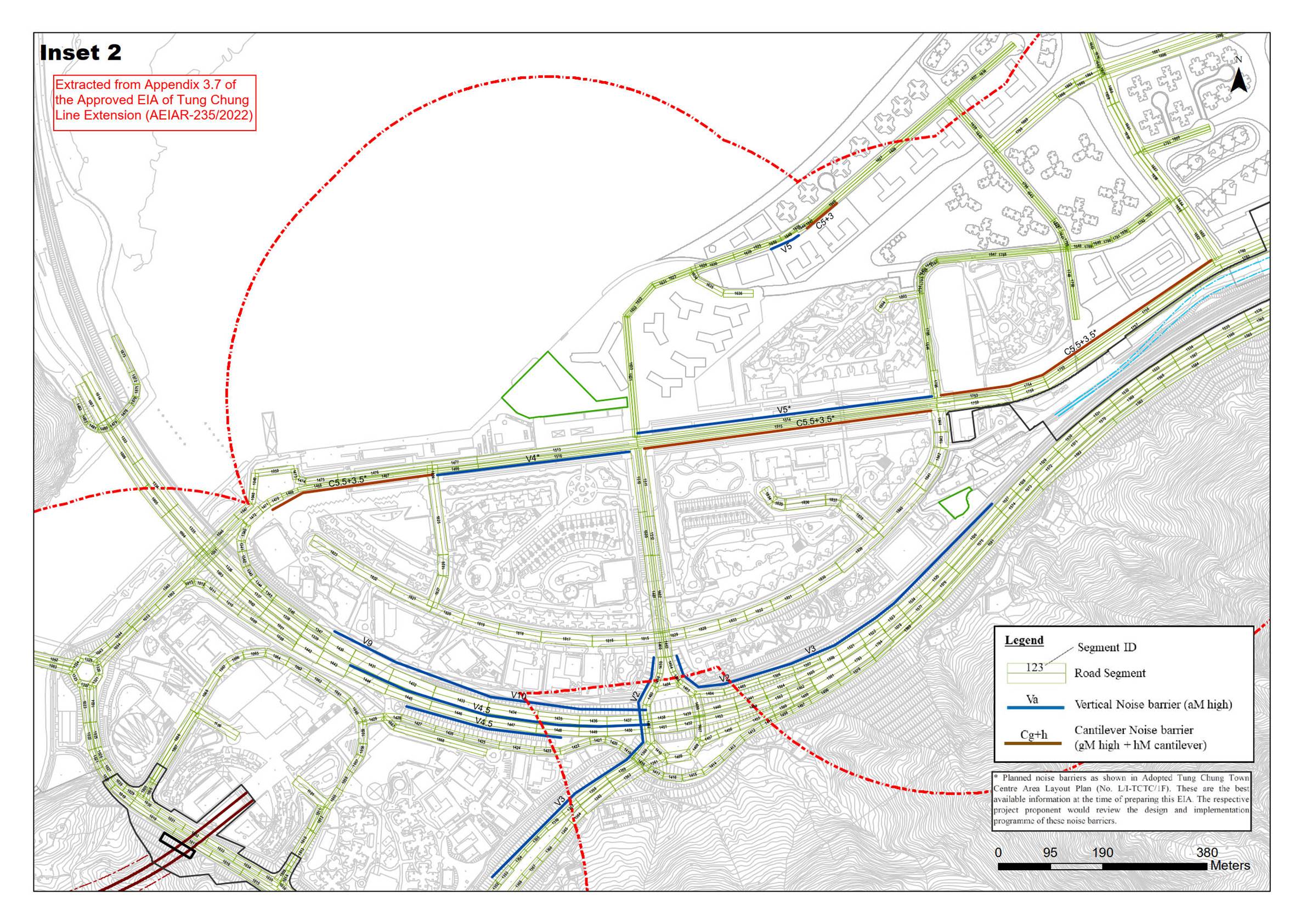
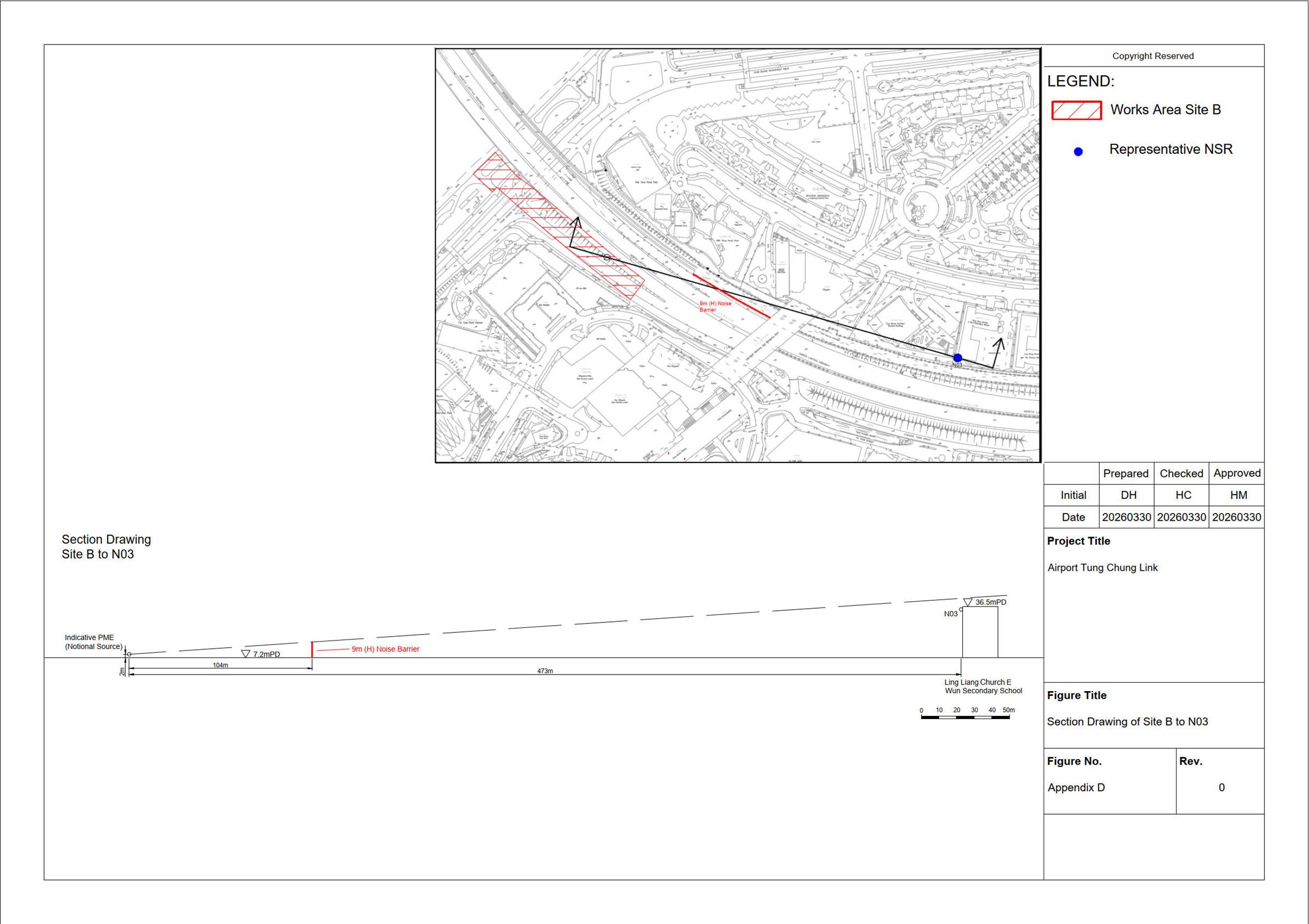
The screening effect due to existing
structures/barriers nearby the Project Site such as Novotel Citygate Hong Kong,
Fu Tung Plaza, The Silveri and the noise barrier for Airport Express Line have
been considered in the prediction of construction noise levels. Where
appropriate, -10 dB(A) or -5 dB(A) screening effect has been adopted in the
construction noise calculations. Further details can be referred to Appendix C and D.
For worst-case scenario, the noise mitigation
criteria for schools were set to 65 dB(A) for all months. As shown in Table
7.1, the construction noise levels at the identified representative
construction NSRs would range from 70 to 76 dB(A)
for residential use and 64 to 70 dB(A) for schools under the unmitigated
scenario. Noise exceedances are found at Seaview Crescent (N01), Tung Chung
Crescent (N09), as well as Ling Liang Church E Wun Secondary School (N03),
Ching Chung Hau Po Woon Primary School (N05) and Po On
Commercial Association Wan Ho Kan Primary School (N06) during examination
period. Noise mitigation
measures are therefore required to alleviate the construction noise impact on
the affected NSRs.
Table 7.1 Predicted Construction Noise Levels under Unmitigated Scenario
|
NSR ID |
Description |
Uses |
Predicted
Construction Noise Level, Unmitigated, Leq
(30mins), dB(A) |
Noise
Standards, dB(A) |
Noise
exceedance, dB(A) |
|
N01 |
Seaview Crescent |
Residential |
74-76 |
75 |
1 |
|
N03 |
Ling Liang Church E Wun Secondary School |
School |
67-70 |
65 |
5 |
|
N05 |
Ching Chung Hau Po Woon Primary School |
School |
64-66 |
65 |
1 |
|
N06 |
Po On Commercial Association Wan Ho Kan
Primary School |
School |
64-66 |
65 |
1 |
|
N08 |
Fu Tung Estate |
Residential |
70-72 |
75 |
0 |
|
N09 |
Tung Chung Crescent |
Residential |
72-76 |
75 |
1 |
Note:
[1] Cumulative noise
level of other concurrent projects had been considered for N09 Tung Chung
Crescent.
Concurrent Project and Cumulative Impact
The Railway Development Strategy 2014 (RDS-2014)
announced by the Government of the Hong Kong Special Administrative Region
included the conceptual scheme of Tung Chung West (TCW) Extension and a
possible Tung Chung East (TCE) Station. The works areas and construction programme of Tung Chung Line Extension have been reviewed
based on latest available information. The location of the concurrent project
is shown in Figure 6.1. According to Construction Noise Management Plan
(Jan 2026) for Works Contract 1201, their latest works areas and works sites
are within 300m of the one of the NSRs (Tung Chung Crescent) of this Project (Appendix H refers). It is noted that the representative NSR
at Tung Chung Crescent in this CNMP is facing away from the construction site
of Tung Chung Line Extension, a conservative construction noise level from the
construction site of Tung Chung Line Extension at Tung Chung Crescent in
Construction Noise Management Plan (Jan 2026) for Works Contract 1201 had been
adopted in cumulative assessment for conservative approach. The cumulative
construction noise impact from construction of Tung Chung Line Extension is presented
in calculation Appendix C.
It is noted that the Sewerage Upgrade Works of the
Three Runway System (3RS) would be constructed near the TCCS and is expected to
commence in June 2026. The location of the sewerage upgrade works has been
indicated in Figure 6.1. As advised by Contractor, the PME adopted under
“Sheet Pile” at Site G is equivalent to the PME adopted for the sewerage
upgrade works. In this assessment, the sewerage upgrade works has been treated
separately as Site I and included in the construction noise calculation, as
shown in Appendix B, C and F.
Use of Quieter PME and Quality Powered Mechanical Equipment (QPME)
Taking into account the latest construction programme and PME
inventory provided by the Contractor, quieter PME for mobile crane, air compressor, generator and excavator are proposed as listed in Table 7.2. However, if the exact model
specified in the references/QPME labels of the listed quieter PME are not
available, or the QPME label has expired during the construction period, the
model with SWL not higher than the listed SWL shall be adopted.
Table 7.2
Quality PME Proposed for Adoption during
Construction Phase
|
PME |
Reference
[1] |
SWL,
dB(A) |
|
Mobile
Crane |
QPME:
EPD-12661 |
108 |
|
Air
Compressor |
QPME:
EPD-11726 |
100 |
|
Generator |
QPME:
EPD-12349 |
90 |
|
Excavator |
QPME:
EPD-16451 |
107 |
Note:
[1] The SWL is
prescribed in Quality Powered Mechanical Equipment (QPME) in
EPD website.
Quieter Construction Methods
The below quieter construction methods have been
considered and assumed to be applied in all construction works areas in the EIA
Report (AEIAR-254/2023). As advised by the Contractor, the methods shall be
applied construction works whenever applicable.
·
Hydraulic concrete crusher can be used for rock breaking activities
during site establishment, instead of traditional hydraulic breaker.
The operation principle of hydraulic breaker is by percussive striking actions
of its chisels, while hydraulic concrete crusher is by clamping action.
According to EPD website, the sound pressure level at 7m from the equipment is
67-69 dB(A). The Contractor advised that there are no
rock breaking in the construction works of entire
construction period, therefore, this method is not applicable. Nevertheless, if
there are any updates in the construction works that are relevant to the
specific quieter construction method, the method shall be re-considered
whenever applicable.
·
Non-explosive chemical expansion agent can be
used for concrete breaking activities during site establishment, instead of
traditional hydraulic breaker. The agent is a
slow-acting chemical compound and expand, and cracks
the structure. Significant noise, ground vibration, fly rock, gas, dust or any
other environmental pollution would not be generated during the process. The
Contractor advised that only road surface breaking is involved in the
construction works of entire construction period, no concrete breaking
activities are anticipated, therefore, this method is not applicable.
Nevertheless, if there are any updates in the construction works that are
relevant to the specific quieter construction method, the method shall be re-considered whenever applicable.
·
Quieter type saw (e.g. diamond wire saw, diamond blade saw) is a
flexible sawing technique that can be applied under various situations with
excellent cutting performance. It
will be used instead of excavator-mounted breaker for site formation and road
works as far as practicable, subject to actual site conditions. According to
the EPD website, the sound pressure level at 7 meters from the quieter type saw is 76-81 dB(A). As a conservative approach, both
quieter type saw and excavator-mounted breaker have been included in the
construction noise calculation.
·
Self-compacting concrete can be used for concreting works, instead of
traditional vibratory poker. Self-compacting concrete is highly fluid and
non-segregate, which can spread into place, fill the formwork, and encapsulate
the steel bar reinforcement without using vibratory poker or other PME. The
Contractor advised that the use of self-compacting concrete in bore piles poses
significant challenges in quality control due to the risk of segregation
(separation of components) or bleeding (water rising to the surface),
therefore, this method is not applicable.
·
Silent piling by Press-in Method (Press-in piling) can be used for sheet
piling works, instead of traditional massive augering
and piling machines (e.g.: Piling, vibrating hammer). Press-in method is a pile
penetration method which accurately installs pre-formed piles through static
loading piling. The construction work can also be completed in shorter duration
so that the noise impact to nearby NSRs can also be further alleviated.
According to the EPD website, the sound pressure level at 7 meters from the
equipment is 69 dB(A). The Press-in method would be applied during piling works
at TCCS.
·
Use of pre-casting and prefabrication technology, such as precast
concrete blocks will be applied in seawall construction to reduce on-site
construction work.
Use of Noise Barrier, Noise Enclosure and Noise Insulating Fabric
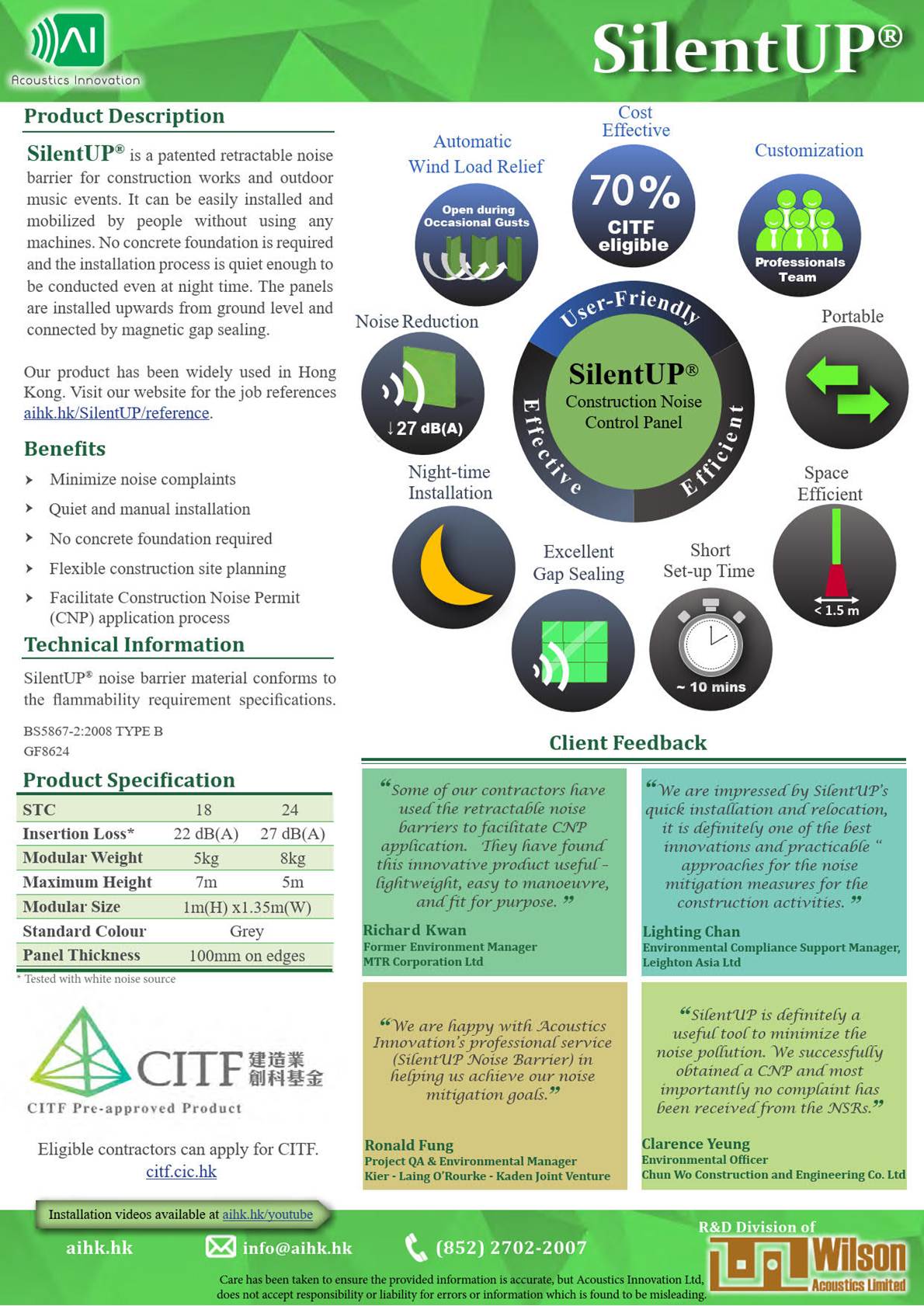
Proprietary noise barriers (SilentUp)
will be used for screening noise to NSRs and could achieve an insertion loss of
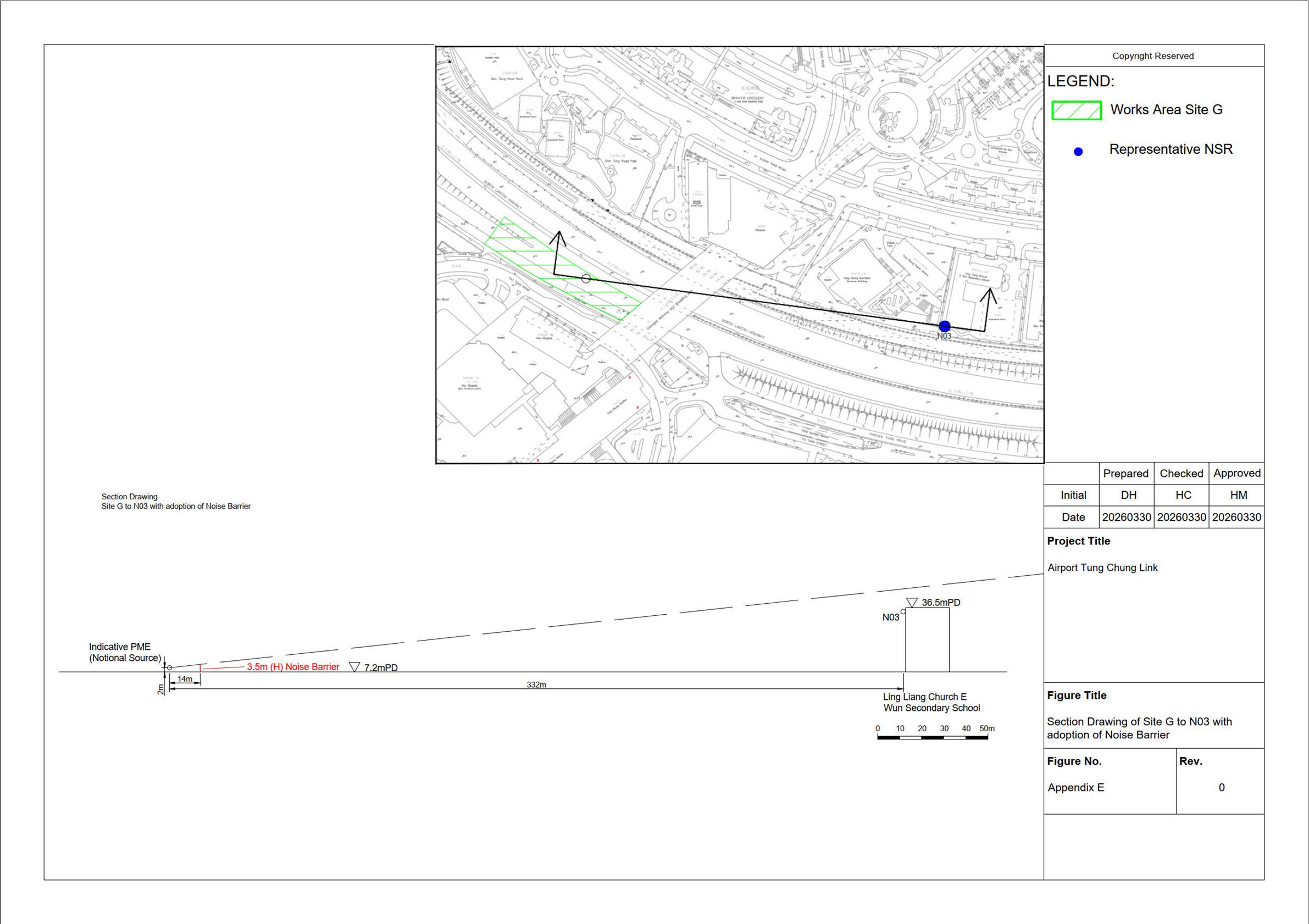
22 dB(A). 3.5m(H) noise barrier shall be provided for the some PME (refer to Appendix B) at Site G to block the direct line-of-sight to
N03. The noise barrier should be placed as close as practicable to the PME intercepting
the direct line-of-sight between NSR and PME such that the noise barriers are
capable to shield the PME from the NSR completely. The catalogue and schematic
drawing of noise barrier is shown in Appendix E. Gaps and openings at joints in the barrier
material should be avoided. The barrier should also be long enough to minimize
the degradation caused by the diffraction along the short edges. With reference
to EIAO Guidance Note No.9/2023, noise reduction of 5 dB(A) and 10 dB(A) can be
achieved by noise barriers for movable and stationary plant respectively.
Following the assumptions in the Approved ATCL EIA Report, it is anticipated
that suitably designed movable barriers/acoustic sheet barriers could achieve
at least 5 to 10 dB(A) reduction. For a conservative assessment, only a
reduction of 5 dB(A) is assumed.
Other noise mitigations such as noise enclosure and
noise insulating fabric shall be considered if necessary.
Use of Soundproof Hammer Bracket for Hydraulic Breaker
Soundproof
hammer bracket will be installed to reduce the noise
from hydraulic breaker. According to the Best
Practice Guide for Environmental Protection on Construction Sites, hammer bracket can achieve 10 dB(A) noise reduction. The mitigation will include tuned
mass dampers installed on the breaker head; tailored breaker cloth wrapped
around the breaker head (minimum 7kg/m2 surface density); and noise
mitigating plastic skirt wrapped around the chisel tip of the breaker.
Prediction and Evaluation of Construction Noise Impact (Mitigated)
The implementation schedule of proposed mitigation
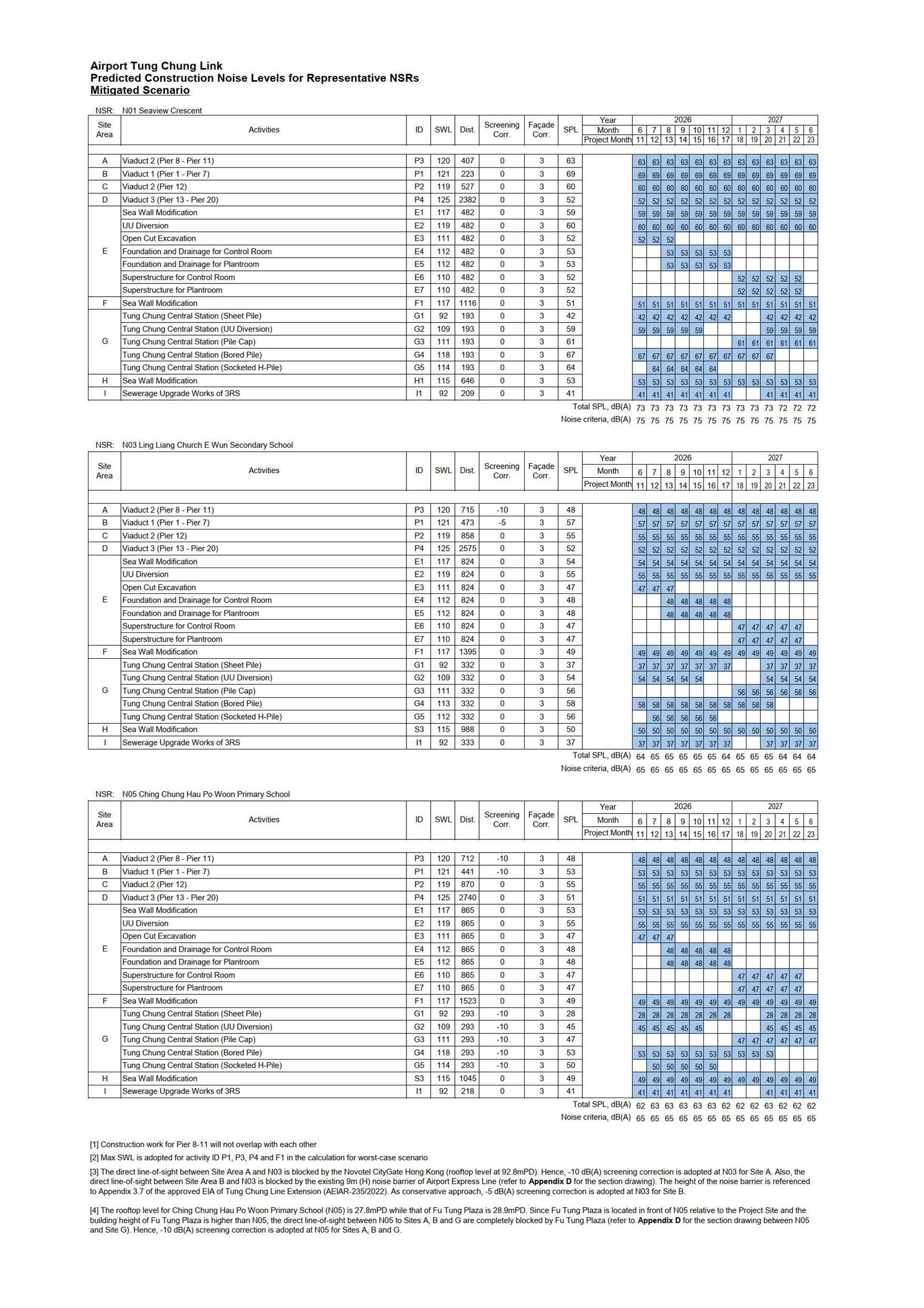
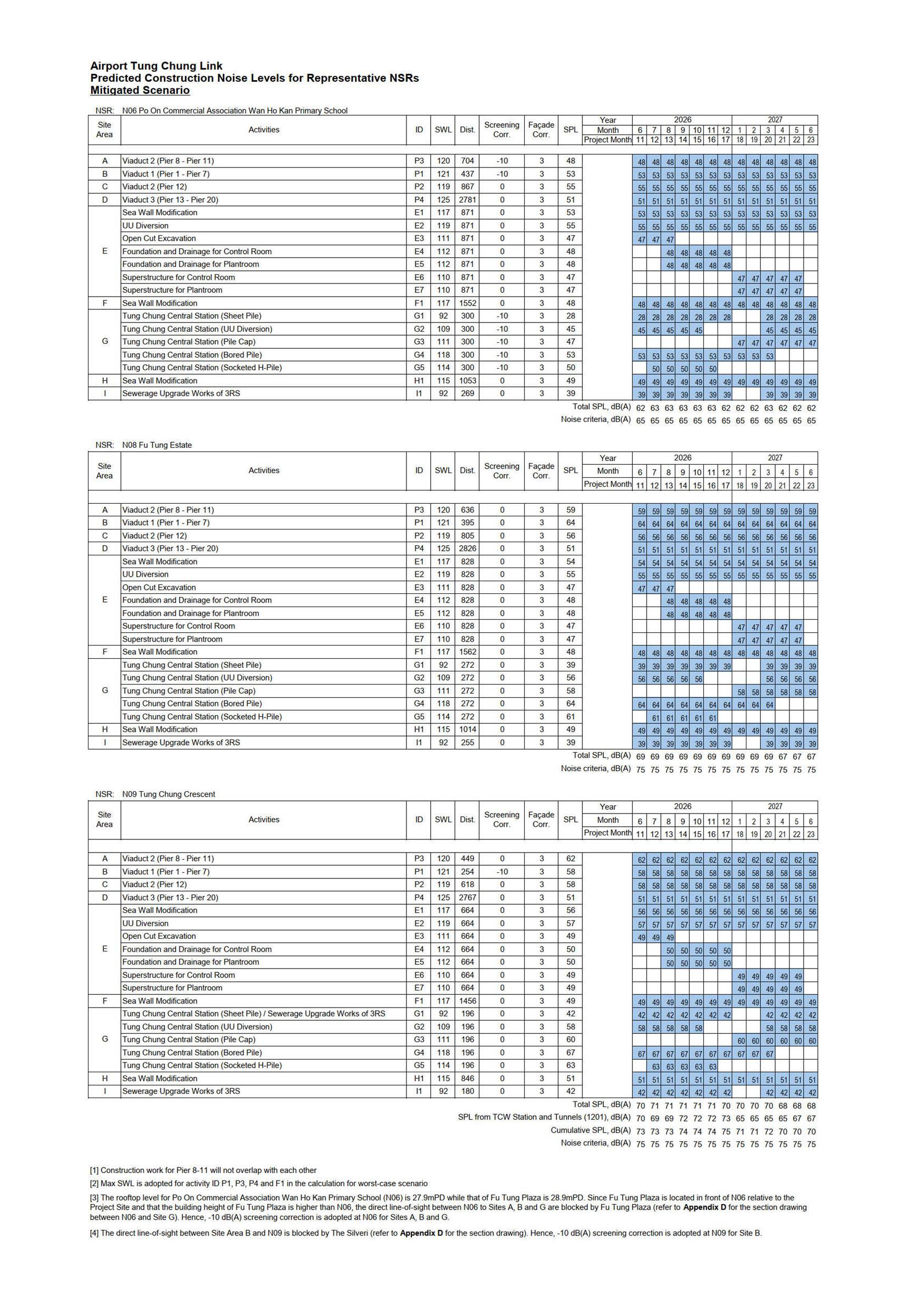
measures is shown in Appendix G. With the implementation of noise mitigations, the
predicted construction noise levels at representative construction NSRs have
been predicted and presented in Appendix F with the results summarized in Table 7.3. The relevant
construction plant inventory could be referred to Appendix B.
Table 7.3
Predicted Construction Noise Levels under Mitigated
Scenario
|
NSR ID |
Description |
Uses |
Predicted
Construction Noise Level, Mitigated, |
Noise
Standards, dB(A) |
Noise
exceedance, dB(A) |
|
N01 |
Seaview Crescent |
Residential |
72-73 |
75 |
0 |
|
N03 |
Ling Liang Church E Wun Secondary School |
School |
64-65 |
65 |
0 |
|
N05 |
Ching Chung Hau Po Woon Primary School |
School |
62-63 |
65 |
0 |
|
N06 |
Po On Commercial Association Wan Ho Kan
Primary School |
School |
62-63 |
65 |
0 |
|
N08 |
Fu Tung Estate |
Residential |
67-69 |
75 |
0 |
|
N09 |
Tung Chung Crescent |
Residential |
70-75 |
75 |
0 |
With the implementation of proposed noise
mitigations, the predicted construction noise level would comply with the
relevant noise criteria, adverse construction noise impact would not be
anticipated.
8.
Good Site Practices
- Only well-maintained plant
should be operated on-site and plants should be
serviced regularly during the construction period;
- Mobile plant, if any, should be sited as far
from NSRs as possible;
- Plant known to emit noise strongly in one
direction should, wherever possible, be properly orientated so that the
noise is directed away from the nearby NSRs;
- Use of site hoarding as a noise barrier to
screen noise at low level NSRs;
- Machines and plant
that may be used intermittently should be shut down between works periods
or should be throttled down to a minimum; and
- Any material stockpiles and other structures
should be effectively utilized, wherever practicable, to screen the noise
from on-site construction activities.
9. CONCLUSION
This CNMP has identified the noise source inventory
and assessed the necessity of construction noise mitigation measures, including
the use of quality powered mechanical equipment, noise barriers and noise
enclosures for works at ATCL project. With the implementation of the proposed
noise mitigation measures and recommended good practices, noise impacts during
construction phases are expected to achieve full compliance of relevant noise criteria.
This CNMP focused on the construction works conducted during June 2026
to June 2027 only and the remaining construction period is subject to change.
The Contractor will submit other CNMP reports for the remaining construction
period once the details become available. If there is any update on the
construction works conducted from June 2026 to June 2027, a revised CNMP will
be submitted to the EPD.
Figure 6.1:
Project Location
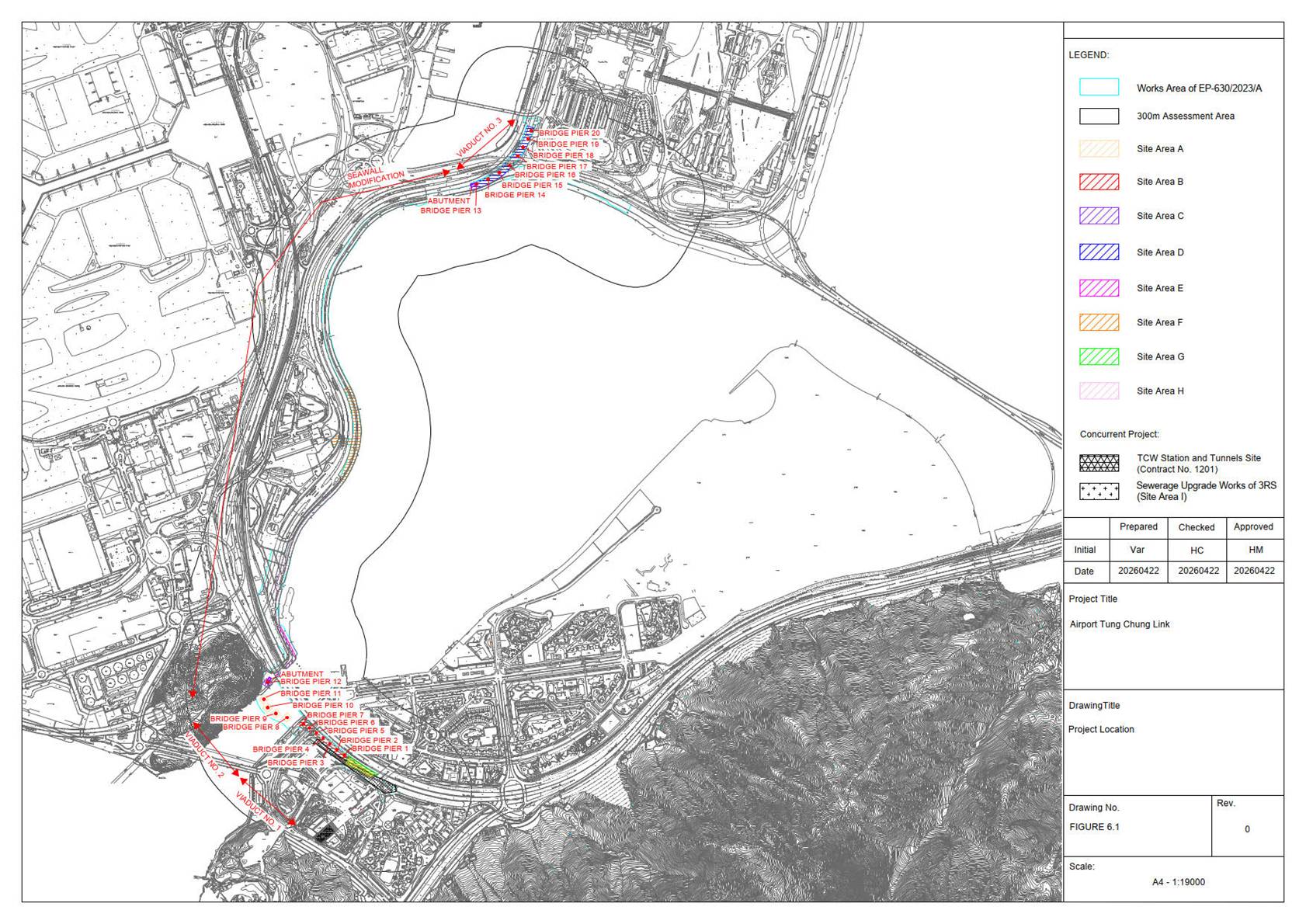
Figure 6.2:
NSR Location
Appendix A:
CONSTRUCTION Programme
Appendix B:
proposed construction plant inventory
Appendix C:
Construction noise calculations (Unmitigated)
Appendix D:
Reference to existing Noise bArrier and Section Drawing of existing
Structures/Barriers
Appendix E:
catalogue and SECTION drawing of noise barrier
Appendix F:
Construction noise calculations (Mitigated)
Appendix G:
Implementation Schedule of Proposed Mitigation Measures
Appendix H:
Extracted CNMP for Tung Chung Line Extension project Submissions under
EP-614/2022